What if every roof in London that could support nature became a living habitat? What if, instead of recreating the gardens and meadows we have always known, we designed our cities around the life that can actually thrive in them? For Dusty Gedge, pioneering green roof advocate and urban biodiversity expert, this is more than an appealing idea. It is a practical vision for the future of our cities, challenging the way we think about green roofs, urban nature and the role of biophilic design.
As climate change brings increasingly extreme temperatures, heatwaves and intense rainfall, we need to rethink what we plant, where we plant it and what we expect nature to do. In our conversation for the Journal of Biophilic Design, Dusty made one thing clear: the objective is not just to make our cities “green”, it is to put life back into them. And just like the Journal here, he encourages us to go back to the original meaning of Biophilia to help us understand the bigger picture.
Dusty’s journey began with a rare bird in Deptford. His interest in birdwatching led him to brownfield habitats and the possibility of recreating them on rooftops. This inspired the concept of the “brown roof”: not necessarily brown in colour but designed to replicate habitats that support wildflowers and wildlife.
Yet, too often, green roofs are treated as products designed to deliver a particular appearance. We imagine lush meadows, manicured lawns and verdant gardens lifted into the sky. But these are not always the most appropriate habitats for rooftops, particularly as our climate changes.
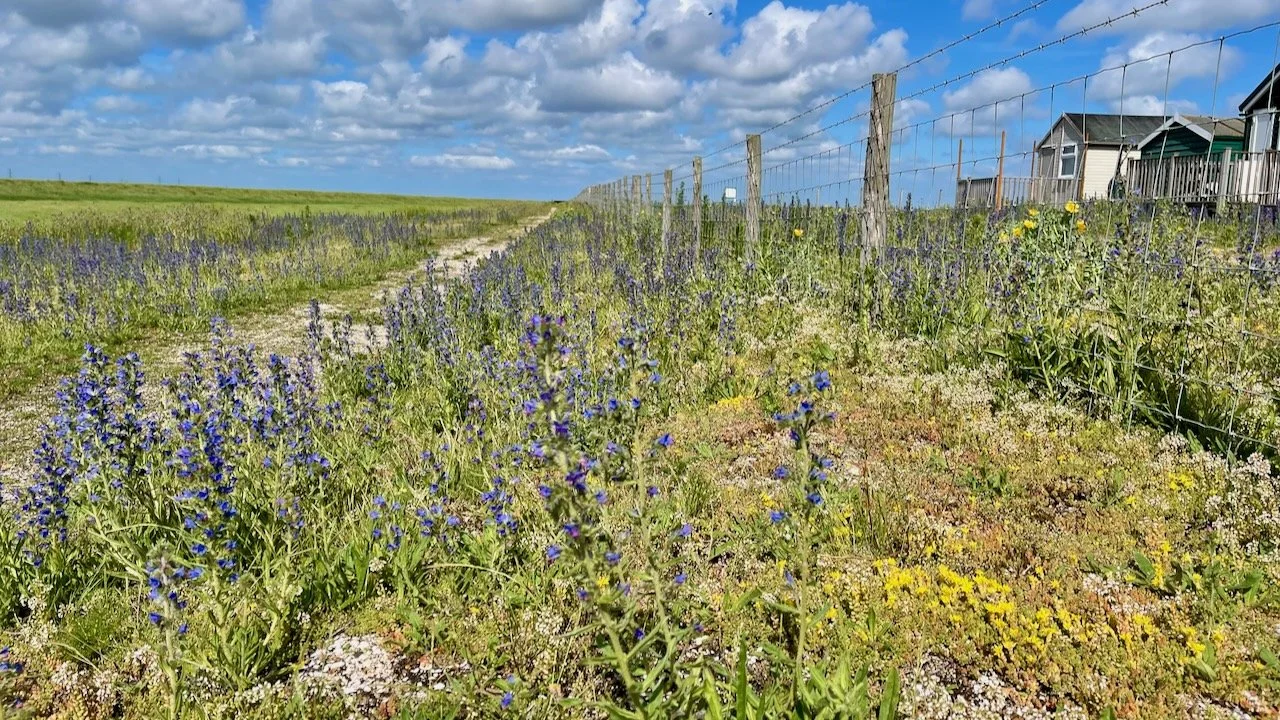
Seasalter Cockleshell Beach
Dusty points instead to vegetated shingle, cockle-shell beaches, sand dunes and alluvial river gravels. These environments are exposed to wind and sun, with limited nutrients, much like many rooftops. Their vegetation may be sparse, but it can be remarkably well adapted to challenging conditions. A cockle-shell beach in Kent, he suggests, provides an excellent model for an extensive biodiverse roof in London. Nature does not always need to look lush to be thriving. A roof that appears brown in places may be supporting plants adapted to survive heat and drought, without constant irrigation.
Designing for a changing climate
As heatwaves intensify and rainfall becomes increasingly unpredictable, our approach to urban planting must evolve. Landscapes that depend on regular watering to remain verdant may become less sustainable, while buildings and cities need better ways to manage intense rainfall. Dusty argues that we must start by understanding the conditions plants will face. Substrate depth, drainage, water retention, exposure and structural loading all matter. So does choosing plants that can survive the environment rather than those selected purely for their appearance.
Some of the most resilient plants are small and understated. Others grow much taller than a designer might expect. Rather than forcing plants into rigid planting schemes, we should create the right conditions and allow nature to find its own balance. This requires a shift in thinking, from controlling nature to working with it, to make design more intelligent, informed by ecology and the realities of a changing climate.

Biophilia is about our connection to life
For Dusty, biophilia is about how people connect with nature. He recalled meeting a man in Saudi Arabia who spoke emotionally about wanting to touch a palm tree in Riyadh. The palm represented an oasis, something meaningful in a predominantly desert landscape. The story illustrates why nature cannot be reduced to a single aesthetic. A desert can be beautiful. So can a windswept rooftop filled with wildflowers, or a patch of vegetation supporting insects and birds among concrete and glass.
Biophilic design should respond to the nature of a place, its climate and its cultural context, rather than impose an idealised image of an English garden everywhere.
A truly biophilic city is a city that makes room for life.
Dusty encourages us to see a city as a network of habitats rather than a collection of isolated buildings. He compares the urban landscape to a mountain range, with different conditions at different heights. Higher roofs are exposed to more wind and sun and may suit dry, sparsely vegetated habitats. Lower levels can support different planting, including shrubs and trees. Balconies, courtyards, gardens and roadside verges all contribute to the wider picture.
By creating a mosaic of habitats, we can support greater biodiversity while helping to cool cities, manage rainfall and improve building performance. There are opportunities to combine these benefits with renewable energy, too. Dusty describes projects exploring biodiverse roofs alongside solar panels, showing how energy generation and habitat creation can work together when designed from the outset. The challenge is to consider these benefits collectively, rather than maximising one at the expense of everything else.
Designing differently
Why are we not doing this everywhere? Dusty believes that conventional design processes are part of the problem. Too often, a building is designed first, and nature is added afterwards as a product. Instead, he argues, we should begin by asking what a roof needs to achieve, then bring architects, engineers, landscape designers and ecological specialists together to find the best solution.
That means considering biodiversity, overheating, stormwater, irrigation and the building beneath the roof from the beginning. It also means questioning established practices. As Dusty puts it, we need to design for the future, not the past.
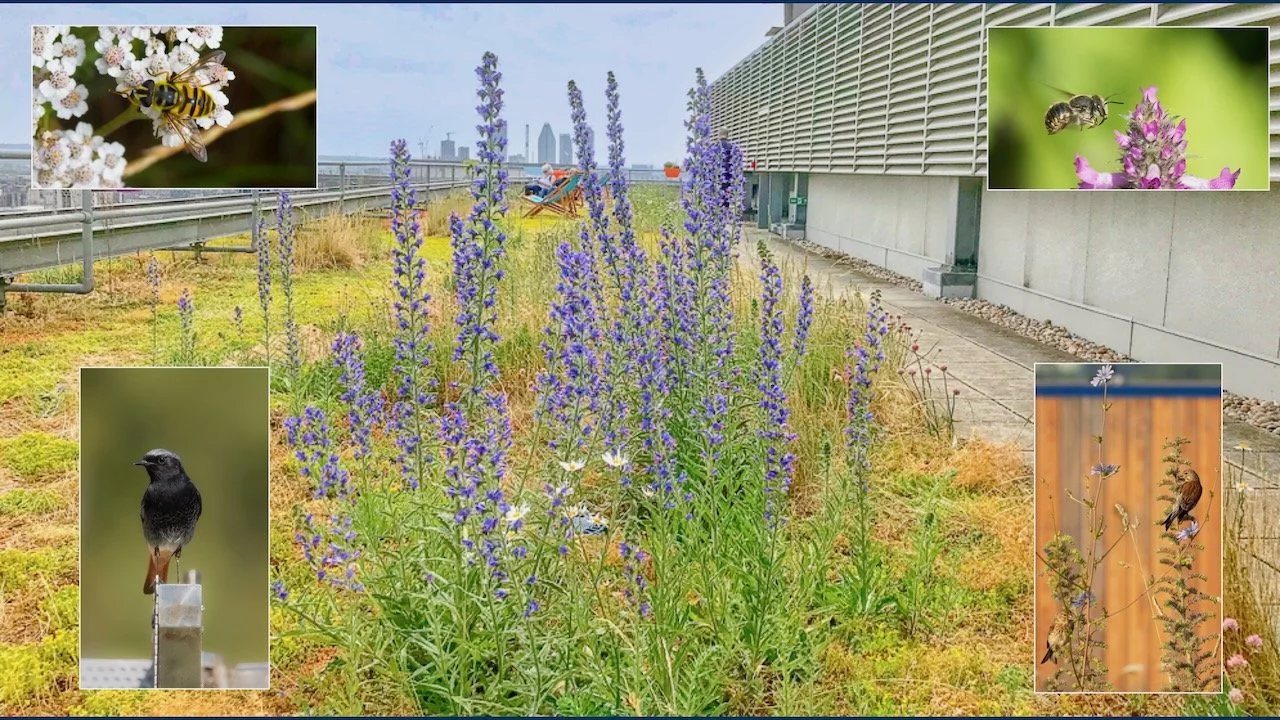
Imagine London alive with nature
Dusty estimates that around 32 per cent of central London could technically be retrofitted with green roofs. Imagine those rooftops becoming biodiverse habitats, inspired by cockle-shell beaches and other resilient natural environments. Imagine wildflowers, insects and birds across the skyline. Buildings helping to cool urban spaces, manage rainfall and provide connected habitats. Imagine cities around the world adapting the same principles to their own climates and ecosystems. Not every roof would look the same. The objective would be diversity, not uniformity.
How amazing would it be if we put life back on all the roofs in London — and then did the same in cities around the world?
As climate change reshapes our environment, biophilic design must mean more than adding plants to buildings. It must help us reconnect with living systems and create places that support life. Let us stop designing for an idealised past and start designing for the climatic and ecological realities of the future. And let us ask of every roof, every building and every city we create: What life could we put back here?
To find out more about Dusty’s work https://dustygedge.co.uk
Eversheds-Sutherland for an example of a biodiverse green roof - https://youtu.be/v2qc-E2bsQk
Plus Dusty has a whole series of videos about green roofs linked to post-industrial sites and habitats such as sand dunes, shingle and shell as well as alluvial river gravels, based on ideas he brought back from Switzerland 26 years ago.
https://www.youtube.com/playlist?list=PLIkmZVFauIAo6yx3b0O7xCKellht-rOEV
Find out more about Biophilic Design and Climate Change mitigation in Issue 22 of The Journal : https://journalofbiophilicdesign.com/shop/biophilicdesign-climate-change-r88jm
What is Biophilic Design? https://journalofbiophilicdesign.com/what-is-biophilic-design
Want a free copy of the Journal? Visit: https://journalofbiophilicdesign.com/free-materials-issue
Be the first to learn about new research, events, networking and biophilic innovation: https://mailchi.mp/journalofbiophilicdesign.com/50-free-subscription-promotion
Credits: with thanks to George Harvey Audio Production for the calming biophilic soundscape that backs all of our podcasts.
Listen to our podcast on Audible, Amazon Music, Spotify, iTunes, YouTube and all the RSS feeds.
https://www.facebook.com/journalofbiophilicdesign/
https://www.linkedin.com/company/journalofbiophilicdesign/
https://www.instagram.com/journalofbiophilicdesign
If you like this,please subscribe!