There are many places where we can feel an overwhelm, for some of us, the overwhelm can be, well, overwhelming and trying to find somewhere to recalibrate can be difficult.
So how can design help us feel safe, connected and able to participate in the world? Designer and interdisciplinary artist Freyja Sewell begins with nature, sensory experience and a willingness to imagine things differently.
As a neurodivergent designer herself, Freyja is founder of HUUS Design, where she brings together art, technology, nature and sensory design to create gorgeous woven soft felt pods and other products including digital capability to help create environments that support human experience better. Her work is also woven by an ambition to make positive futures tangible.
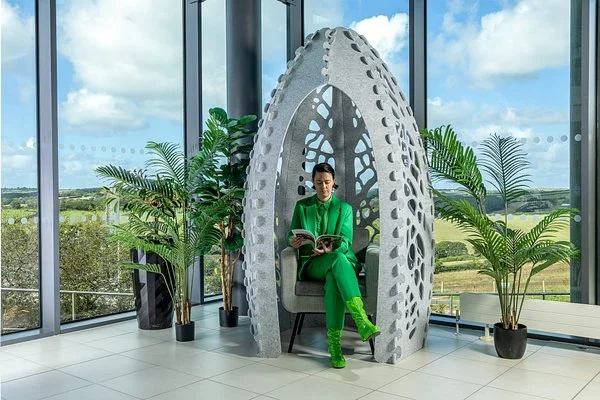
From lived experience to inclusive design
Freyja’s journey began with her own experience of feeling overwhelmed by certain environments. As an autistic designer, she understands how noise, stimulation and a lack of privacy can make everyday spaces difficult to navigate.
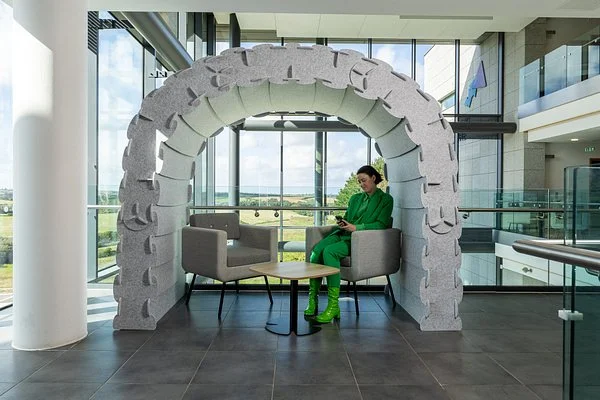
Rather than treating this sensitivity as a limitation, she has increasingly come to recognise how it can inform her creativity. That perspective led to the development of the HushPod, a freestanding, closable felt structure that creates a small, private retreat within a larger environment. Developed after university, the original concept emerged from her need to find somewhere peaceful to go when the world became too much.
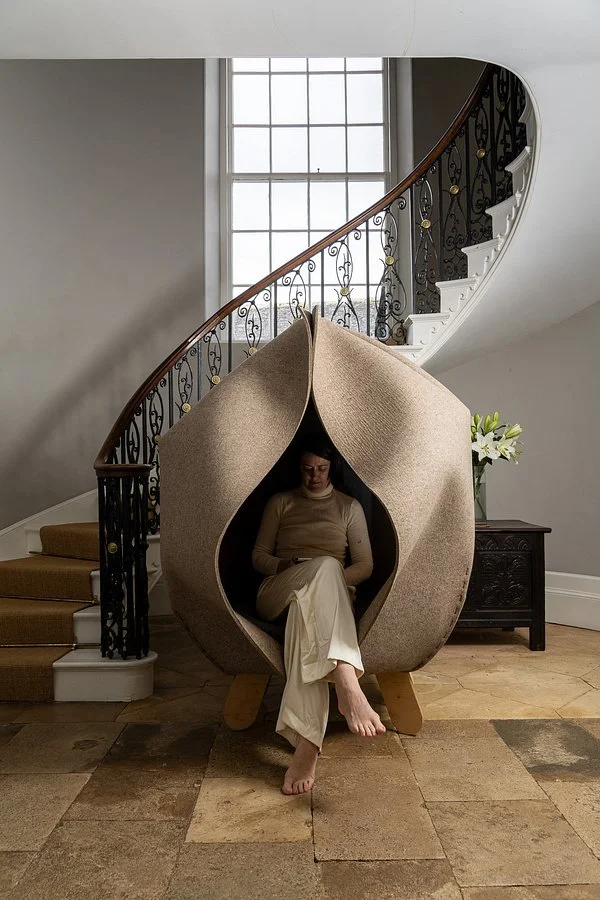
HushPod
Freyja experimented with different materials before discovering thick wool felt. Its combination of strength, softness and tactility offered the qualities she was seeking, namely a beautiful object that could provide both physical enclosure and a sense of calm. Inspired partly by the womb-like quality of the form, the HushPod offered an alternative to retreating to a toilet (which a lot of people do!) or withdrawing entirely from public life! The response from others was also positive. People recognised their own need for quiet, privacy and space to regulate their emotions and senses. A personal design solution had revealed a much wider need.
Bringing the forest into our everyday spaces
Nature has been a constant source of inspiration for Freyja, and biophilic research and principles now underpin both her artistic and design practice.
She describes the forest as a genuinely immersive experience. The sensation of walking on the ground, the smells, the sounds, the air and the textures all contribute to an encounter that engages the whole body.
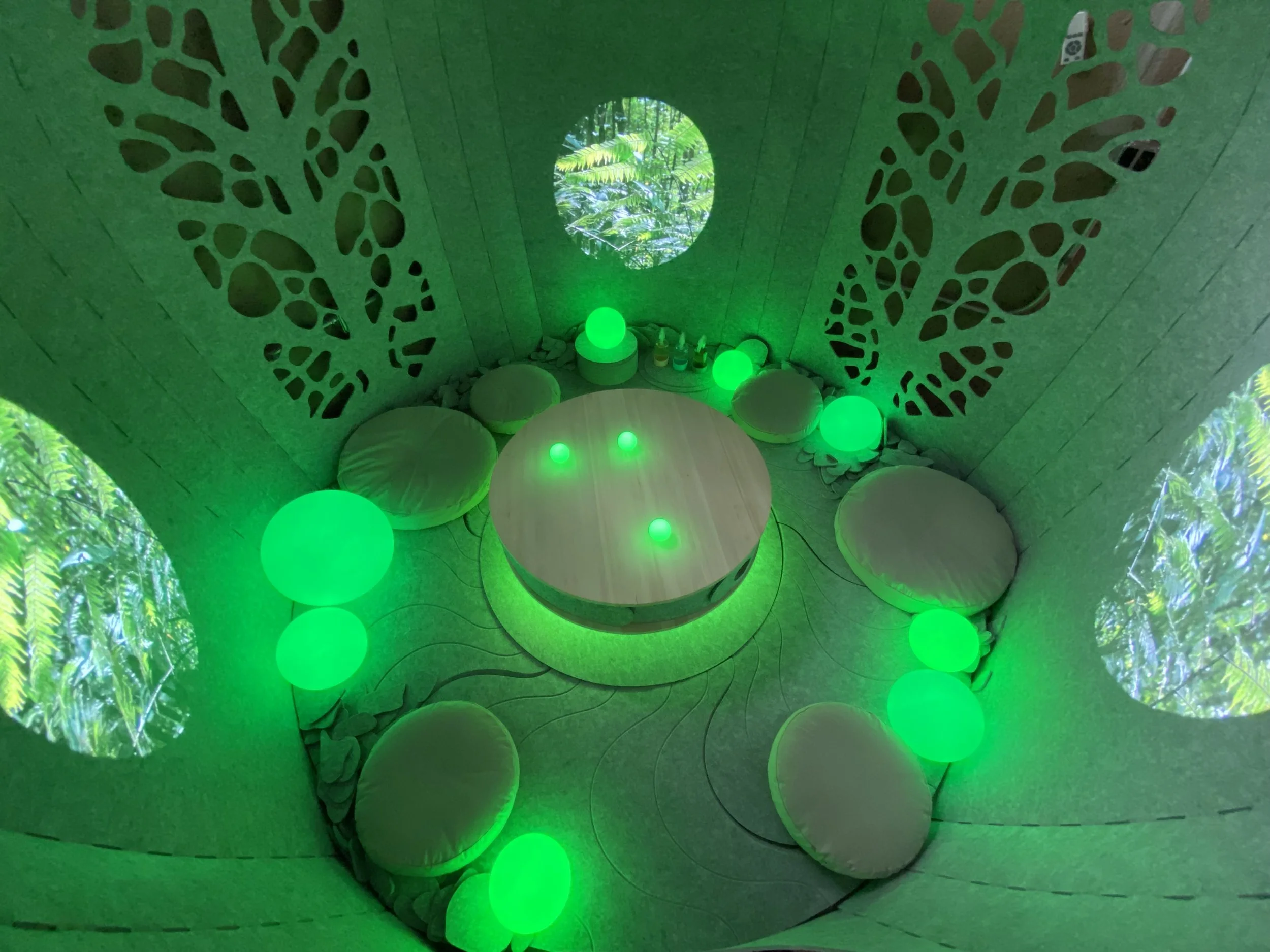
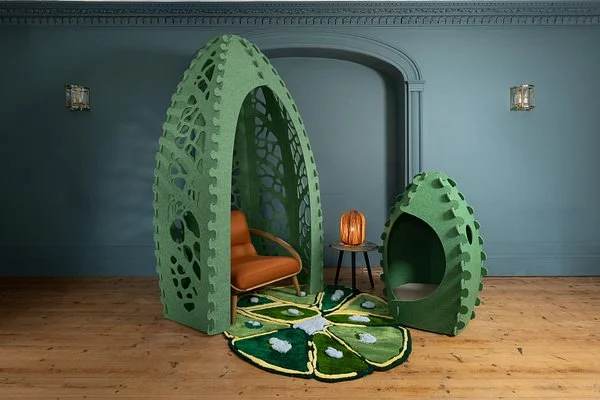
Yet not everyone can easily access these experiences. Physical barriers, socioeconomic circumstances and the realities of urban life can all limit opportunities to spend time in nature. Her approach seeks to distil some of nature’s qualities into environments to meet people where they are.
Through sensory spaces, including an art therapy pod developed in collaboration with Ebony Easley, she explores how design can bring elements of nature into settings where people may need additional support. These spaces can offer an introduction to nature’s restorative qualities, while encouraging a deeper connection with the living world beyond their walls.
A different vision of the future
Freyja’s thinking is also shaped by her experiences in Japan, where she has lived three times. She is fascinated by approaches that understand nature and technology as interconnected rather than opposing forces. For her, a positive future is one in which these relationships become reciprocal: technology exists in ways that support a healthier balance between people and the natural world.
This vision depends on creativity and diverse ways of thinking. Repeating familiar approaches, she suggests, is unlikely to produce fundamentally different outcomes. That makes neurodiversity an important part of the conversation about the future of design.
Making room for everyone
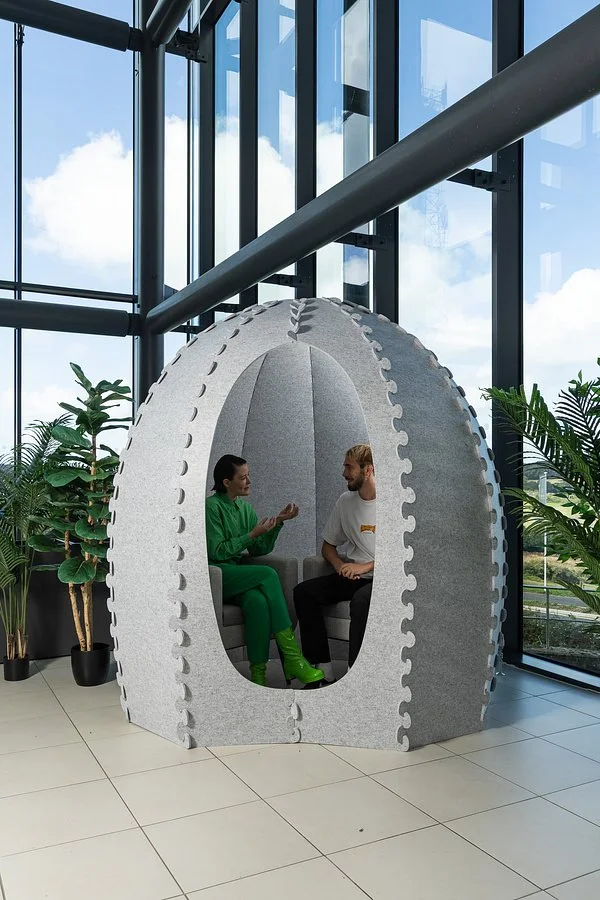
Where would she like to see her designs make the greatest difference? In restaurants and bars, where quieter retreats could help neurodivergent people participate more comfortably in social life; in educational settings, where young people could find opportunities to regulate and contribute; and in hospitals, where patients, families and staff may need moments of calm amid stressful surroundings; and environments in which more people feel able to belong.
Perhaps that is one of the most important lessons biophilic design can offer, noteably designing for wellbeing means looking beyond how a space appears to consider how it feels to inhabit it.
By listening to different experiences of the world, embracing sensory diversity and drawing inspiration from nature, we can begin to imagine places that work for more of us.
Explore further: Discover the Journal of Biophilic Design’s Neurodiversity Issue, featuring research, science and inspiration for creating spaces that work for everyone.
To learn more about Biophilic Design and how it can help support neuroinclusivity, download you own copy: https://journalofbiophilicdesign.com/shop/journal-of-biophilic-design-issue-9-neurodiversity-ebook-version
To learn more about Freyja’s work visit: https://www.freyjasewell.co.uk
Neurodivergent, neurodiversity and neurotypical: a guide to the terms
https://www.thebraincharity.org.uk/neurodivergent-neurodiversity-neurotypical-explained/
What is Biophilic Design? https://journalofbiophilicdesign.com/what-is-biophilic-design
Want a free copy of the Journal? Visit: https://journalofbiophilicdesign.com/free-materials-issue
Or better still become a member and you have access to that and over 20 other science packed editions of the Journal of Biophilic Design. https://journalofbiophilicdesign.com/subscribe-as-a-member
The world of biophilic design delivered to you – join us: https://mailchi.mp/journalofbiophilicdesign.com/50-free-subscription-promotion
Credits: with thanks to George Harvey Audio Production for the calming biophilic soundscape that backs all of our podcasts.
Listen to our podcast on Audible, Amazon Music, Spotify, iTunes, YouTube and all the RSS feeds.
https://www.facebook.com/journalofbiophilicdesign/
https://www.linkedin.com/company/journalofbiophilicdesign/
https://www.instagram.com/journalofbiophilicdesign
If you like this,please subscribe!