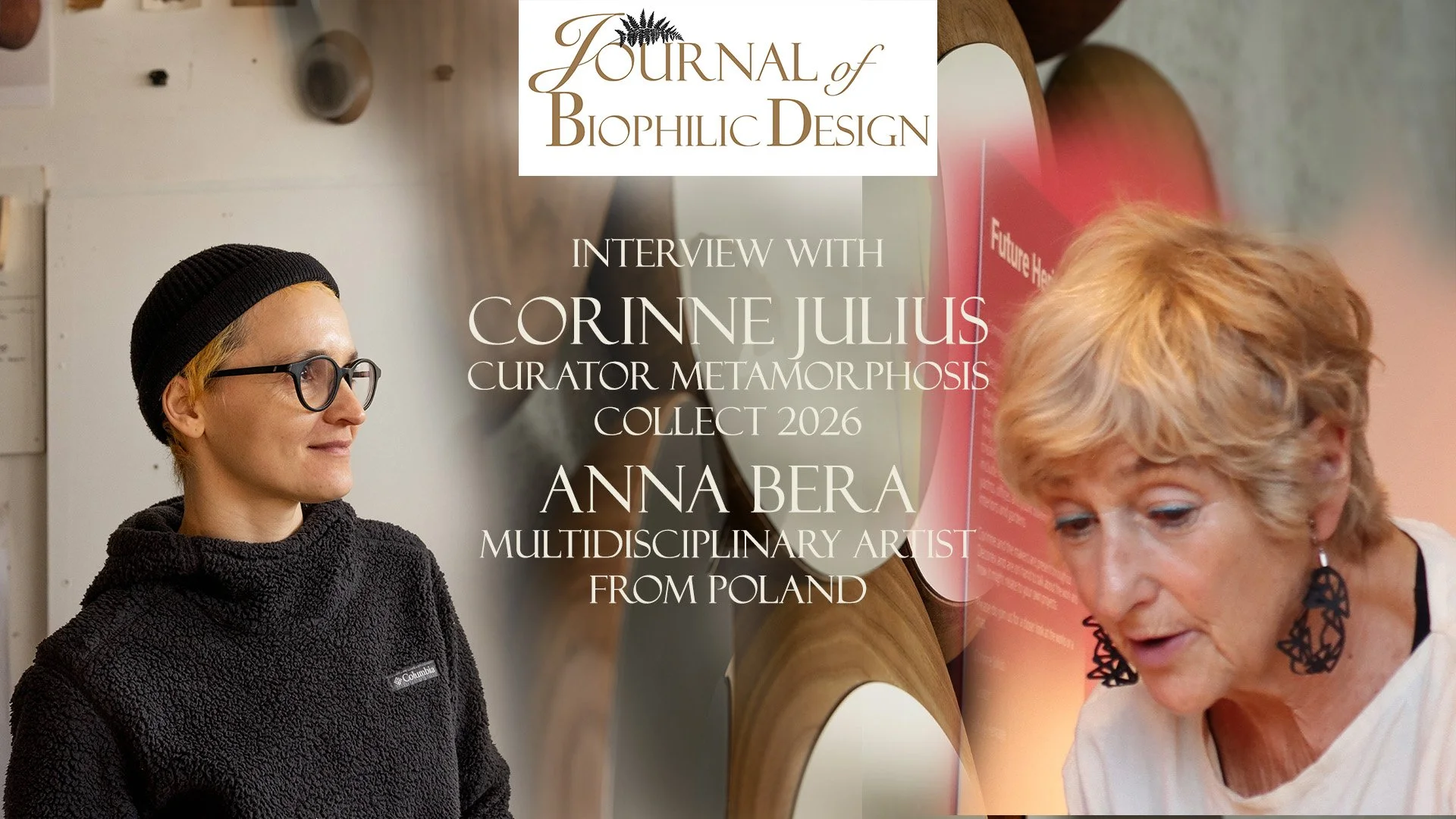
Polish craft and innovation is going to take centre stage at Collect 2026 which opens in London on 25 February this year 2026. Nature connection, craft and design is taking centre stage. Biophilic Design helps people reconnect with nature. I am also a maker and artist (I sculpt, weave, sketch, etc), and for me, creating things with natural materials gives me a direct connection to nature and our planet. In this podcast we speak with the curator of this year’s Collect Corinne Julius and one of the Polish artists featured during the show. We explore the significance of biophilic design, the metamorphosis of Polish craft, and the role of materiality in art. The conversation also touches on the challenges of the craft industry in the context of climate change and the importance of tactile experiences in our lives. Can slow craft be the antidote to the disconnection and environmental crisis we face today?
How to Design a Biophilic Community
Nestled in the Chattahoochee Hills, Georgia, is Serenbe, the biophilic community leading the wellness real estate and agrihood movements. It is a neighbourhood focused on wellbeing, full of fresh food and fresh air. This community is set among acres of preserved forests and meadows with miles of nature trails that connect homes and restaurants with arts and businesses.
Importantly it is a real-world example of Biophilic Design in a community development that can help us reimagine urban and town planning.
We speak with Steve Nygren, Founder and CEO who shares with us his love of biophilia and how this is woven through Serenbe, a beautiful and practical reimagining of how we can live in harmony with nature. More than just a development, Serenbe is a living, breathing testament to Biophilic Design and the profound connection between human well-being and the natural world…
READ on and Watch the interview…
Light, Play and Possibility - in conversation with Frankie Boyle, experiential light artist
Light profoundly impacts our neurological and biological systems through its connection to our evolutionary history. Our brains are fundamentally programmed to respond to moving, dynamic light sources - which is why we're instinctively transfixed by a candle flame. Artificial light, by contrast, has only existed for 180 years, which is essentially nothing in evolutionary time. This means static white lights do little to support our relaxation or psychological connectivity. We speak with Frankie Boyle, light artist extraordinaire who fuses physics, psychology, neuroscience and art.
Frankie’s work is beautiful, a manifestation of the fusion of biophilia and creativity. I love the gorgeous fluidity, the colours, the dance of light and dark, for me experiencing her installations even through the screen feels like you are walking into a song.
As Frankie explains, humans have been interacting with light for 4 billion years, primarily through natural sources like sunlight and fire.
From a neurological perspective, light triggers specific responses in our nervous system that are deeply rooted in survival mechanisms. Our brains are programmed to detect movement because it signals potential hunting opportunities or threats. Different colours and light intensities activate different neurological responses - for instance, vibrant blues are energising and motivating, while sunset tones with yellows and oranges signal relaxation and the end of the day. These light interactions influence our brain's energy allocation. If we design lighting intentionally, we can help encourage the neural resources of anyone experiencing the space to focus on specific tasks, ultimately improving their cognitive performance and emotional well-being.
READ ON AND WATCH THE INTERVIEW…..
Wool Revolution - Why every Biophilic Designer needs to know about this..
In a laboratory in Manchester, a quiet revolution is brewing that could dramatically reshape the construction industry's environmental impact. LAMDA, a groundbreaking wool insulation panel, promises to challenge the dominance of petrochemical-based building materials while offering a sustainable, health-conscious alternative.
Vicente Orts Mercadillo from Vector Homes and Ruth Marie Mackrodt of Wool Insulation Wales are pioneering a material that does far more than simply keep buildings warm. Their innovation tackles multiple environmental and health challenges simultaneously.
"Construction is responsible for around 40% of global carbon emissions," explains Ruth, highlighting the urgent need for sustainable alternatives. In the UK alone, 9% of the national carbon footprint comes from manufacturing construction materials. The LAMDA panel's credentials are impressive.
Sustainability meets Design elegance - the LINK Design
Biophilic Design has so many aspects to it, it is not just plants, greenery, light, colour ways, it is also about using natural materials in products, using natural materials to enhance a space and provide happiness and comfort to those using it. I spoke to the design team of AAID, Allen Architecture Interior Design, working together they created an hexagonal modular wall system made out of sustainable local and recycled materials which also employ local artisans and labour. Just as we do, each 'LINK” block relies on the one below, and can be adapted as shelves, planters, like little pods. Obviously the hexagon is an important shape in nature, just look inside a Bee Hive.
Arts in Healthcare and Beyond
Should art in hospitals and elsewhere incorporate biophilia? With the arts quite starved of funding generally incorporating visual arts into healthcare and other environments is a challenge. We speak with Victoria Hume, Director of the Culture, Health and Wellbeing Alliance to find out how the Alliance is helping broker arts into healthcare and beyond through a network of regional “champions”, building on grassroots arts programmes and building bridges to network positive creative solutions to those who need it. Her own background as a musician and arts worker is fascinating in itself, as is her work on delirium which includes composing music that address delirium.