Bringing the beauty of nature to you
The Journal of Biophilic Design publishes and broadcasts research into the health, environmental and economic benefits of Biophilic Nature-inspired Design.
We campaign for Biophilic Design implementation in healthcare, workplace, education, homes and cities worldwide for people and planet.

If you need help, speak to us, we help broker Biophilic Design expertise, consultancy, and delivery across our wide network of specialists.
Not sure where to start? Take a subscription to our Journal and learn about the benefits of Biophilic Design. We bridge the gap between research and practice of biophilic design and nature-based solutions through publishing and broadcasting international case studies, thought leadership and evidence to help mitigate and improve the Environmental, Health and Economic impact of design, build and construction.
We have over 30,000+ monthly podcast listeners, our printed and ebook Journal is distributed worldwide and on university reading lists. Listen to our archive of interviews, case studies and evidence from architects, urban planning to home design, designers or join us at one of our many events online and in person in 2025, including our annual conference.
Pre-order and reserve your printed edition of The Biophilic Workplace
Discover fresh thinking, inspiring projects and evidence-led ideas for healthier, nature-connected workplaces:
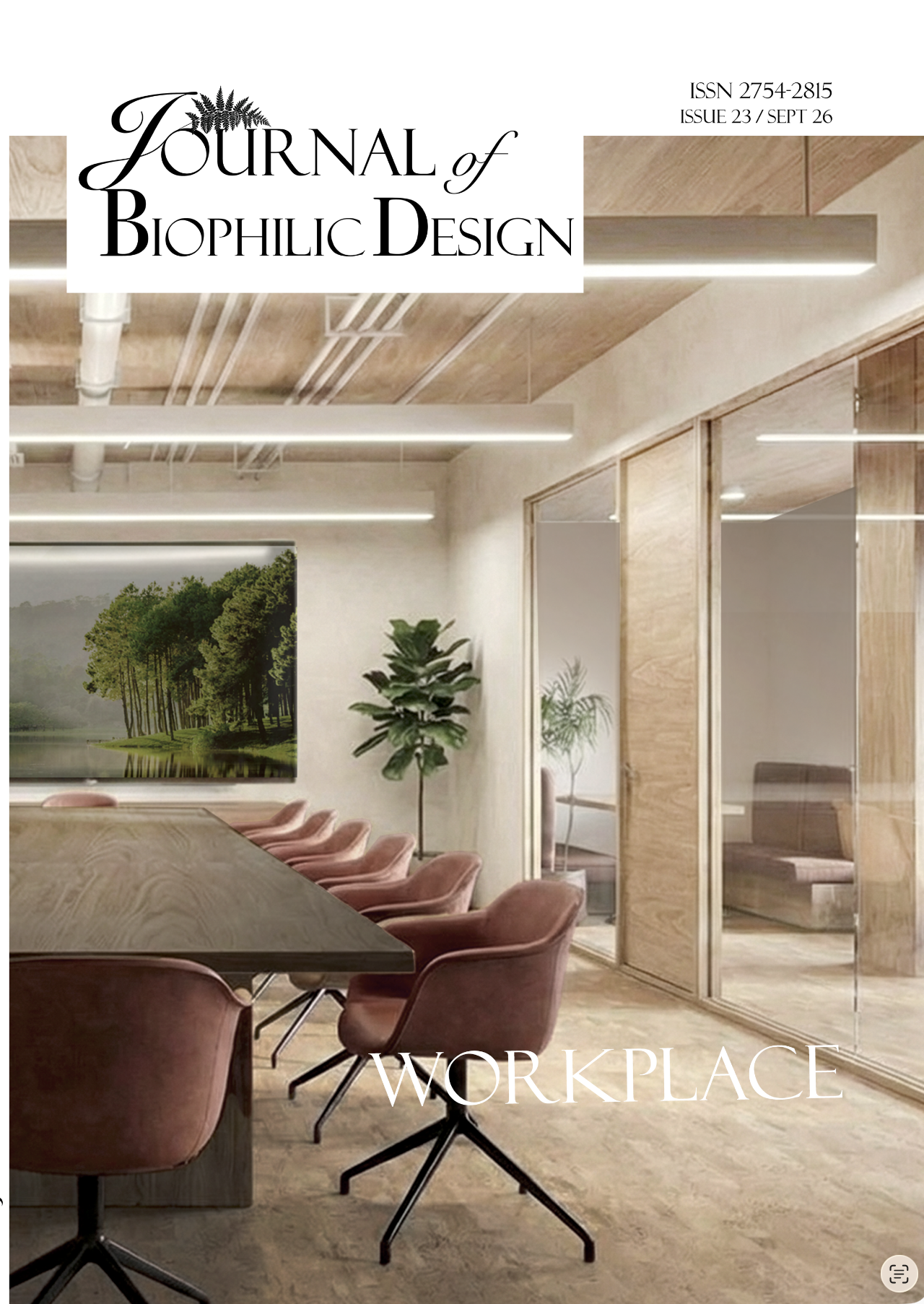
Workplace Revisited - Print Edition | Issue 23
£25.00
Workplace: What Makes a Better Place to Work?
What does it take to create a workplace that supports people’s health, wellbeing and creativity? Is it the light, the materials, the acoustics, the colours, the presence of nature — or the way all these elements work together?
In this Workplace edition of the Journal of Biophilic Design, we bring together researchers, designers, architects, workplace specialists and practitioners to examine how our working environments affect us, and how Biophilic Design can inform better decisions about the places in which we spend so much of our lives.
The issue explores the evidence behind biophilia, including how wellbeing can be measured and how the value employees place on nature can be understood in social and economic terms. We consider the hidden costs of workplaces that overlook human needs, the sensory demands of modern offices, the importance of light for health and an ageing workforce, and how design can support different ways of thinking, working and creating.
We also look at what happens when these ideas are put into practice. How can an uninspiring office be transformed on a limited budget? What can we learn from a thoughtfully designed wellbeing courtyard? How might workplace gardens, green roofs and urban biodiversity contribute to healthier environments? And how can standards such as WELL help translate research into practical design decisions?
Our contributors challenge familiar assumptions, too. Why do so many offices look the same when nature is diverse, changing and sometimes untidy? Can we move beyond the familiar plant wall towards a richer relationship with the living world? What does it mean to design for people rather than simply provide space for them?
The issue also considers the relationship between workplace design and wider environmental responsibilities, from turning waste into value to understanding what birds and green roofs can tell us about biodiversity and climate change.
For architects, interior designers, facilities managers, HR and people professionals, workplace strategists, business leaders, developers and building owners, these discussions offer different perspectives on a shared challenge: creating environments that work better for the people who use them.
Through research, practical examples and professional experience, this edition explores how Biophilic Design can move beyond aesthetics to inform the way workplaces are planned, commissioned, managed and experienced.
The question is not simply how to make an office greener, but how to create places that work better for people, organisations and the natural world.
Discover the Workplace edition of the Journal of Biophilic Design.
Designing with WOOD - Issue 22
Out week of 13 September!
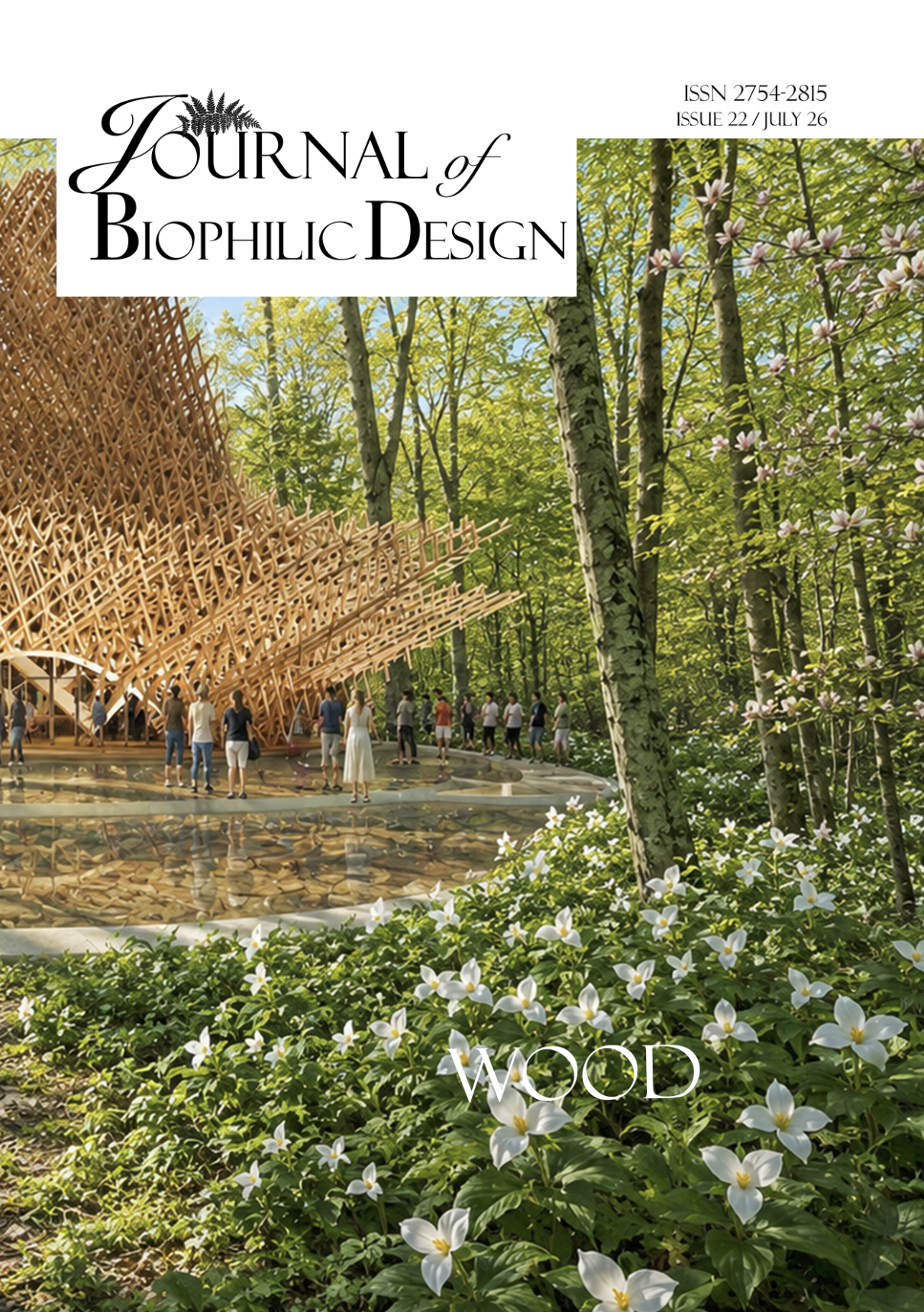
Designing with Wood - Print Edition | Issue 22
£25.00
Wood is more than a material. It is a connection to nature, place, craft, culture and wellbeing.
In Issue 22 of The Journal of Biophilic Design, we explore the many ways wood shapes the spaces we live, work, heal and gather in — and ask what it really means to design with timber thoughtfully.
From the sensory and physiological effects of wood to its role in contemporary architecture, interiors, landscapes and furniture, this beautifully illustrated issue brings together designers, architects, researchers and practitioners to explore timber from every angle.
We look at Wood and Wellbeing, exploring why timber can be much more than a beautiful finish, and visit inspiring projects including healthcare and educational spaces by Farrow Partners. We explore the quiet luxury of craftsmanship, the beauty of American walnut, a woodland sauna, and a London workplace designed around disassembly, circularity and biophilic principles.
There are beautiful homes and buildings from around the world, including La Higuera, Trehus One Maidenhead, Cornwall Barn and Pond Place, alongside explorations of timber transformation, natural variation, solid wood flooring and the relationship between wood, landscape and architecture.
But this issue also asks the harder questions.
Where does our wood come from? How responsibly is it sourced? What does certification really mean? And how can choosing timber support forests, biodiversity and the wider living world?
Our Science Behind Biophilic Design section explores the fascinating relationship between wood, pattern, proportion, mathematics and the Golden Ratio, while Wood – The Multisensory, Physiological Magician examines what the research tells us about our responses to this remarkable material.
And because wood's story begins in the forest, we also look at ancient trees, biodiversity, responsible sourcing, planting, gardens and the organisations helping us understand the complex relationship between trees, timber, people and planet.
A celebration of wood — but also an invitation to understand it, specify it and use it more thoughtfully.
Issue 22 – WOOD.
Beautifully designed, richly illustrated and packed with ideas, research, projects and inspiration for anyone interested in biophilic design, architecture, interiors, landscape, materials and wellbeing.
Designing with Wood - Digital Edition | Issue 22
£4.99
Wood is more than a material. It is a connection to nature, place, craft, culture and wellbeing.
In Issue 22 of The Journal of Biophilic Design, we explore the many ways wood shapes the spaces we live, work, heal and gather in — and ask what it really means to design with timber thoughtfully.
From the sensory and physiological effects of wood to its role in contemporary architecture, interiors, landscapes and furniture, this beautifully illustrated issue brings together designers, architects, researchers and practitioners to explore timber from every angle.
We look at Wood and Wellbeing, exploring why timber can be much more than a beautiful finish, and visit inspiring projects including healthcare and educational spaces by Farrow Partners. We explore the quiet luxury of craftsmanship, the beauty of American walnut, a woodland sauna, and a London workplace designed around disassembly, circularity and biophilic principles.
There are beautiful homes and buildings from around the world, including La Higuera, Trehus One Maidenhead, Cornwall Barn and Pond Place, alongside explorations of timber transformation, natural variation, solid wood flooring and the relationship between wood, landscape and architecture.
But this issue also asks the harder questions.
Where does our wood come from? How responsibly is it sourced? What does certification really mean? And how can choosing timber support forests, biodiversity and the wider living world?
Our Science Behind Biophilic Design section explores the fascinating relationship between wood, pattern, proportion, mathematics and the Golden Ratio, while Wood – The Multisensory, Physiological Magician examines what the research tells us about our responses to this remarkable material.
And because wood's story begins in the forest, we also look at ancient trees, biodiversity, responsible sourcing, planting, gardens and the organisations helping us understand the complex relationship between trees, timber, people and planet.
A celebration of wood — but also an invitation to understand it, specify it and use it more thoughtfully.
Issue 22 – WOOD.
Beautifully designed, richly illustrated and packed with ideas, research, projects and inspiration for anyone interested in biophilic design, architecture, interiors, landscape, materials and wellbeing.
Have you got our Climate Change edition?
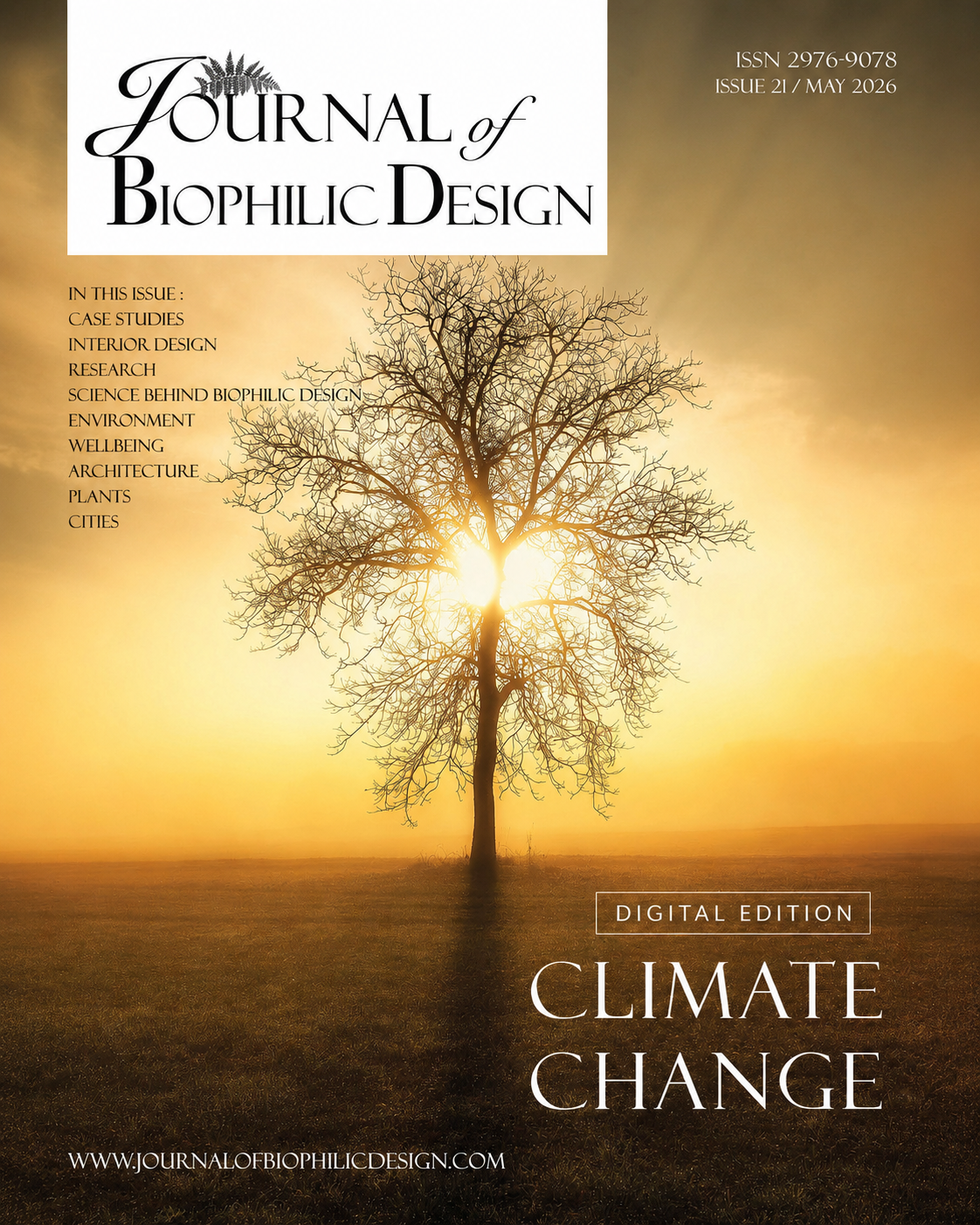
Climate Change, Sustainable Architecture & Biophilic Design — Digital Edition - Issue 21
£4.99
How do we design for a changing climate?
Climate change is changing the places where we live, work, learn and heal. This issue of the Journal of Biophilic Designexplores how biophilic design, architecture, interiors, landscapes, materials and nature-based solutions can help us create healthier, more resilient and more sustainable environments for people and planet.
Across 227 beautifully designed pages, this issue brings together research, science, projects, practical ideas and thought leadership from a wide range of perspectives.
Inside this issue
COOLING A WARMING WORLD
How thoughtful design, urban greening, trees, planting, natural ventilation and water-sensitive landscapes can help us respond to rising temperatures and changing climate conditions.
LUCE, TERRA, OMBRA
Exploring light, earth, shadow and our relationship with natural materials and the cosmos.
CLIMATE FOR CHANGE IN TEXTILES
How material choices and textile design can contribute to more sustainable interiors.
MUD BRICK
What traditional materials and construction approaches can teach us about climate resilience, place and resource-conscious design.
SUSTAINABLE EXCELLENCE
The BIID Interior Design Awards 2026 and the relationship between sustainability, design quality and responsible practice.
BIOPHILIC DESIGN & CLIMATE-CONSCIOUS INTERIORS
How interior designers can bring together wellbeing, material choices, nature connection and environmental responsibility.
DESIGNING FOR LONGEVITY
Why designing things to last may be one of the most important sustainable choices we can make.
BIOPHILIC DESIGN AS A FOUNDATION FOR SUSTAINABLE LIVING
Exploring how our relationship with nature can influence the way we live and the environments we create.
THE SCIENCE BEHIND BIOPHILIC DESIGN
Evidence, research and the science underpinning our connection with nature.
BIOPHILIA AND CLIMATE CHANGE
Why reconnecting people with nature matters in a rapidly changing world.
A NEW CLASSIFICATION FOR BIOPHILIC ARCHITECTURE IN A CHANGING CLIMATE
A fascinating exploration of Mimetic, Applied and Organic Biophilic Architecture, and why meaningful biophilic design needs to go beyond simply making buildings look green.
PLANTS & LIVING WALLS
Including Top 40 Plants from Houseplant Royalty and an exploration of the role living walls can play in alleviating the effects of climate change.
ENVIRONMENT • PEOPLE • PLANET
We also explore circular design, material health, air quality, social impact, changing consumer expectations, wellbeing, climate-conscious places and the role of nature in our cities.
Discover The Circular Hub, explore the thinking behind The Spherical Economy, consider the environmental and health implications of the “new smell”, and look at how design can help us navigate a threshold of change.
The issue also explores climate change through the lens of social impact, local and global design, wellbeing and human experience, including Sea Fever, A Greener Path, Biophilic Cities and Nature as Infrastructure.
WHY THIS ISSUE MATTERS
Climate change demands more than technological solutions.
It asks us to reconsider how we design, what we build with, how we use materials, how we manage landscapes and cities, and how closely our built environments remain connected to the natural systems on which we depend.
Biophilic design offers a practical framework for bringing these questions together — connecting human health, biodiversity, climate resilience, materials, sustainability and our innate need for contact with nature.
This issue brings those conversations together in one place.
WHAT YOU'LL FIND INSIDE
227 pages
Research & science
Architecture & interiors
Materials & sustainability
Plants & living walls
Climate-responsive design
Biophilic cities
Wellbeing
Nature-based solutions
Projects & case studies
Thought leadership
Books & resources
For architects, interior designers, landscape architects, urban designers, sustainability professionals, developers, researchers, educators, students and anyone interested in creating healthier places for people and planet.
Digital Edition — £4.99
Read it on your screen or Kindle, or choose the beautiful full-colour printed edition to keep and refer back to.
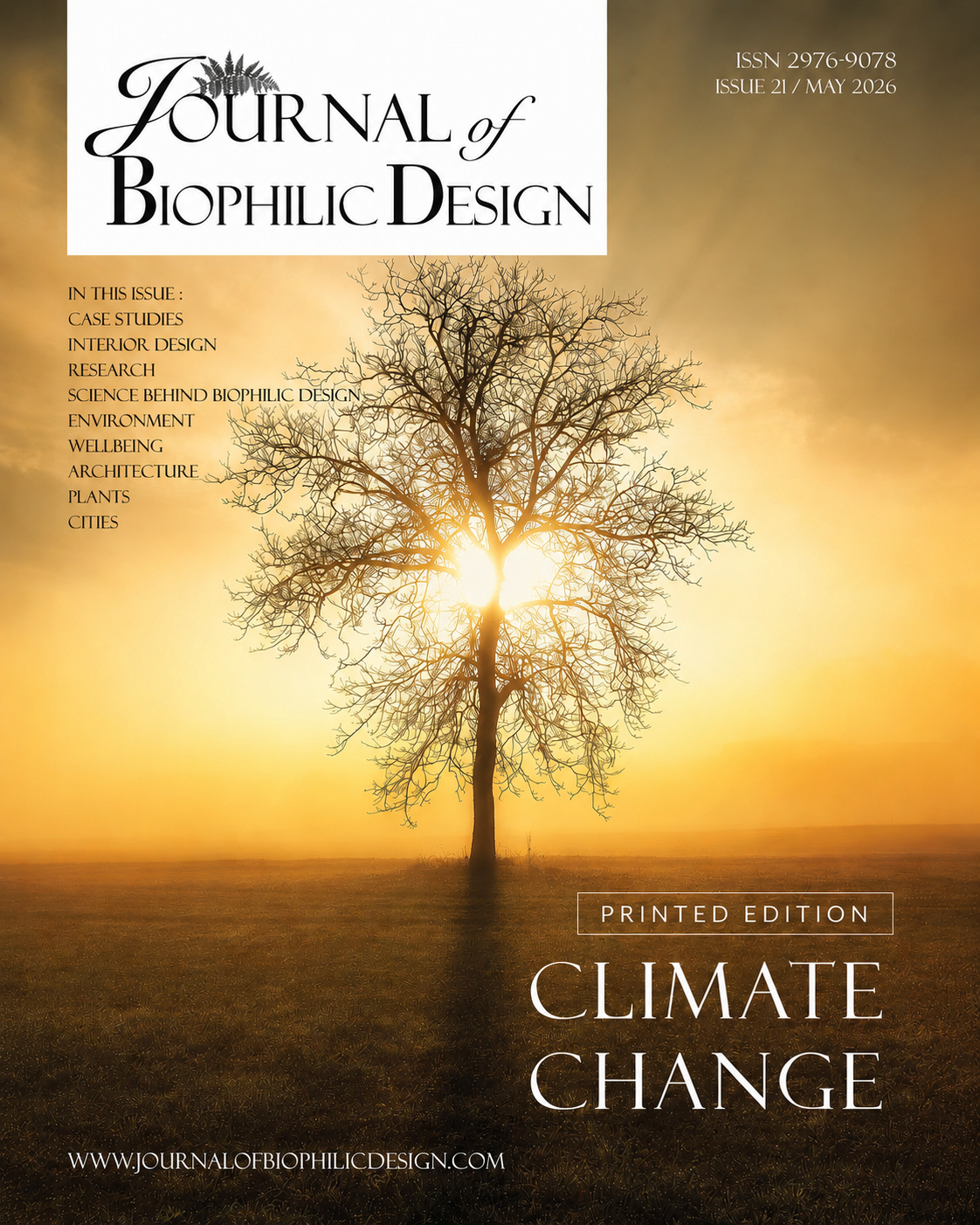
Climate Change, Sustainable Architecture & Biophilic Design — Print Edition | Issue 21
£25.00
CLIMATE CHANGE
227 pages exploring how we can design for a warmer, changing world.
Architecture. Interiors. Cities. Materials. Science. Plants. Wellbeing.
Climate change is no longer a distant environmental issue. It is changing the places where we live, work, learn and heal.
Issue 21 of the Journal of Biophilic Design asks what happens when we put nature at the heart of the response.
Inside this issue:
COOLING A WARMING WORLD
How biophilic and climate-responsive design can help cool buildings and cities, reduce energy demand and create healthier places.
BIOPHILIA AND CLIMATE CHANGE
New thinking about the relationship between human–nature connection, behaviour, resilience and regenerative futures.
A NEW CLASSIFICATION FOR BIOPHILIC ARCHITECTURE
Explore Mimetic, Applied and Organic Biophilic Architecture — and why the distinction matters for the future of design.
THE SCIENCE BEHIND BIOPHILIC DESIGN
What does the evidence actually tell us?
CLIMATE-CONSCIOUS INTERIORS
Materials, longevity, reuse and the choices designers can make to reduce environmental impact.
MUD BRICK
What traditional building techniques can teach us about resilience in a changing climate.
LIVING WALLS & PLANTS
How vegetation can help mitigate heat, support biodiversity and improve the environments we inhabit.
NATURE AS INFRASTRUCTURE
Why trees, wetlands, green roofs and biodiverse landscapes need to be treated as essential infrastructure — not decoration.
Then:
227 pages | Research | Projects | Case studies | Science | Design | Ideas
Digital edition £4.99

“Look up, through the leaves of the trees…
Feel the warmth of the sun on your face….
Take a walk on the beach and feel the sand between your toes….
Hear the effervescent waves cascade softly over rock pools…”
From time immemorial we have been connected to the earth, to the land, to the wind, the rain, the sun, nourishing ourselves from the abundance of fruits and seeds around us, listening to the leaves rustle, watching the birds fly in formation above our heads as they head for different climes, feel the ice cold water in the rivers, or enjoy the grass beneath our feet as we sit and talk around a fire.
As a species, the human race NEEDS a connection to nature.
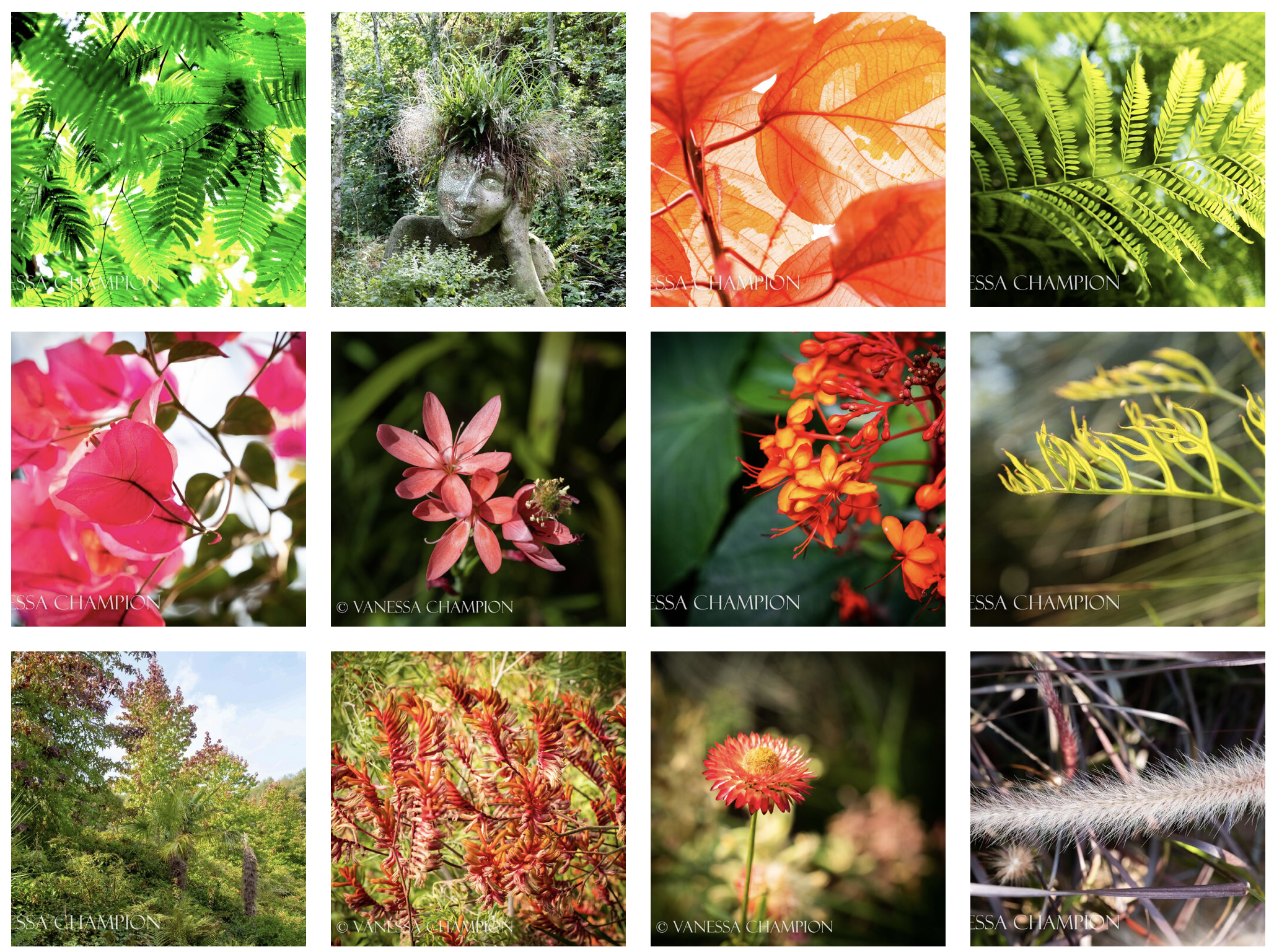
The most obvious way is by getting outside and communing directly with nature, a regular dose of nature does wonders for mental and physical health, general wellbeing and so many other aspects of our lives.
But we spend most of our lives inside, at home, in an office (when we can get there!), in a shop, warehouse, school, hospital, hotel, and so on surrounded by white walls, plastics, TV noise, fluorescent lighting... Many of us operate in cities or towns, there’s concrete, asphalt, cars, cacophonies, hardly any parks or trees, birds are minimal and life is, well, running on empty.
The distance from where our inherent biological connection to the world and ourselves is currently, is a thousand miles away from where it needs to be in many instances.

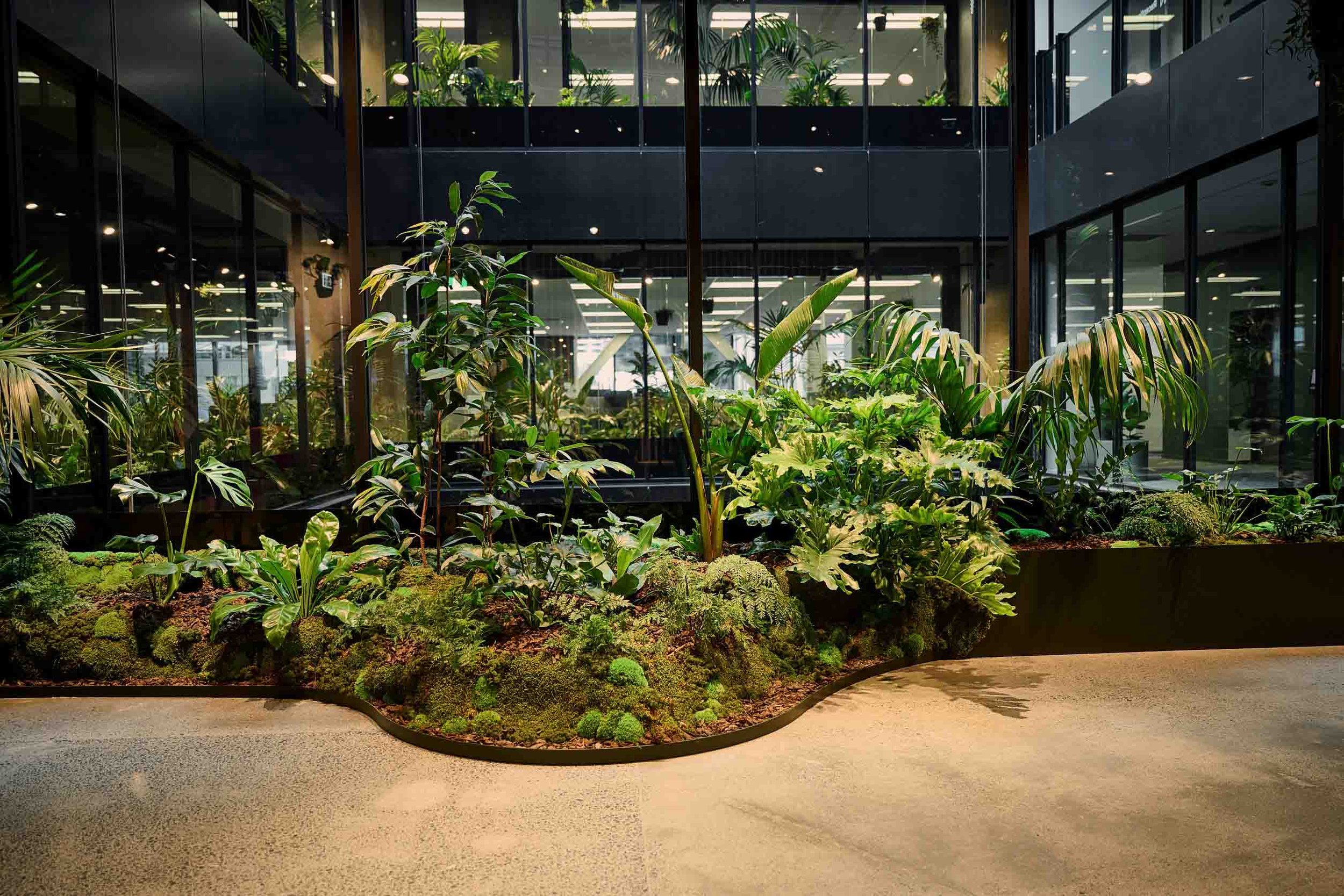
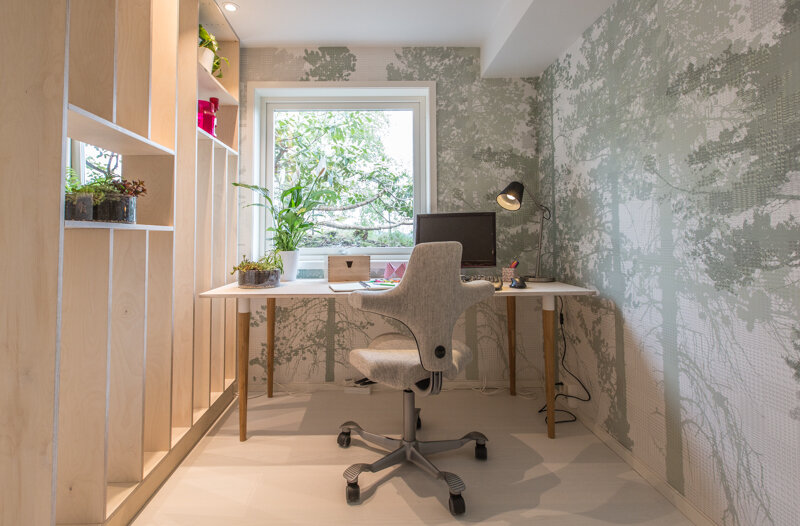
So this is where Biophilic Design comes in. Biophilia is the “love of life, living things”, plants, animals, insects, us, air, flowers, sounds, and textures…. In interior design this is often represented directly, for instance by bringing plants in, encouraging natural light and fresh air or by its virtual representation or mimicking of nature, such as printed views, using colours from nature, soundscaping or improving acoustics. In urban planning, this is about incorporating trees, parks, wildlife corridors, biodiversity, encouraging engagement with nature and communities through pathways and so on.
We broadcast on Biophilic Design through our podcast series, we are media partners to some amazing events which support the Biophilic Design movement, and we publish the ebook and printed Journal as well.
Did you know we also offer a networked consultancy service, advising on the benefits of Biophilic Design from an academic viewpoint, and broker experts from architects to environmental psychologists, designers to landscapers to support your projects, whether that’s commercial, home, hospital, wider healthcare or education design.

Our founder, is Dr Vanessa Champion, herself a professional photographer and film maker who started life as an academic in London. She is the force behind what we do: “An interdisciplinary approach to Biophilic Design celebrates all the aspects of our rich natural world, we look at interior design, environmental psychology, acoustics, urban planning, the benefits of engaging with animals and other living species, how virtual nature views help, why using natural materials (wood, linen, cotton, etc) is beneficial, forest bathing or shinrin yoku, how you use certain scents to improve your mood, and loads more.”
We are an independent press, if you like what we do and would like to support us in some way, we recently signed up to Buy Me a Coffee, which may give you an opportunity to keep up topped up with caffeine each month (and cat food for Miss Emily)! Thank you in advance if you do. xx https://www.buymeacoffee.com/biophilicdesign
MEDIA PARTNER FOR EVENTS THAT ARE MAKING OUR PLANET A BETTER PLACE TO LIVE, WORK AND FLOURISH
Proud to support industry conversation as MEDIA PARTNER
The JBD is super proud to be media partners for some of the Industry’s more inspiring events. We actively support events which are honestly trying to make a difference to the wellbeing of people and planet, whose founders and teams also advocate that we need a more green environment inside and out, and for whom sustainability is an essential achievable goal rather than a nice to have. We attend all of these shows, not just because we think it’s nice to get out of the office (which it is) but because we believe from the bottom of our boots that being in the same room all together we can make a difference, and the different showcases each have a different angle, and you can learn so much from each. Let us know if you’re going and maybe we can meet up too. Either way, get your tickets, and find your inspiration.

We are excited about partnering with the Biophilic Institute in America. Their mission, just like ours, is to ignite biophilic concepts into dynamic actions, cultivate a strong network of passionate professionals and thought leaders dedicated to fostering a biophilic movement, and equip individuals with the tools and knowledge to champion the cause of the natural world
-
We will be speaking there too!
-
We are hosting an event during the Salone 22 April. Email odile@journalofbiophilicdesign. for tickets
https://www.salonemilano.it/en/exhibitions/salone-internazionale-del-mobile
Journal of Biophilic Design makes debut appearance to Host Biophilic Workplace-Focused Panel at Fuorisalone 2026, Milan
Milan, Italy — April 2026 — As Milan Design Week transforms the city into a global hub of creativity and innovation, the Journal of Biophilic Design will make its debut appearance at Fuorisalone with a clear objective: to bridge the gap between design ideas and real-world application.
Hosted within a curated exhibition space developed in collaboration with ANAB and Terra Migaki Design, the Journal’s presence will spotlight practical, implementable approaches to biophilic design. The installation will take place at Pollice Illuminazione, a long-established destination for lighting design in Milan.
Amid a week known for conceptual exploration, this collaboration focuses on tangible solutions — showcasing bio-based materials, circular design thinking, and lighting strategies that can be specified, sourced, and delivered within today’s built environment.
Panel Event: Biophilic Design in Workplaces
📅 22 April 2026
🕕 18:00
📍 Pollice Illuminazione, Via Guido D’Arezzo 11, MilanThe Journal will host a panel discussion examining the role of biophilic design in shaping healthier, more resilient workplaces. Speakers include:
Odile Smith, Sourcing & Commerical Director, Journal of Biophilic Design
Lucilla Malara - Malara Associates
Donatella Mangera - Enviromental Psychologist
Maria Elisabetta Tonali - MateriaVera
Martina Frattura- Beauty-informed Lighting designer
The session will address how natural materials, environmental psychology, and lighting design intersect to influence wellbeing and performance in workplace environments — and, crucially, what it takes to translate these ideas into deliverable projects.
Media Opportunities
Members of the press attending Milan Design Week are invited to visit the exhibition space and attend the panel. Interview opportunities are available in Milan with the European Journal of Biophilic Design Director Odile Smith, alongside the panel speakers and contributing experts behind the installation. -
“Now in its fourth year, the SDC Forum has become a permanent fixture. Curated by SDC for the design community, the Forum provides a unique opportunity for networking, knowledge sharing and purposeful conversations about our industry’s efforts towards greater sustainability to nurture both ‘people and planet’.
Every year, we create a dynamic agenda of presentations, interactive workshops and panel discussions. This year, we are introducing ‘tours’ for designers to meet the suppliers and manufacturers as well as well the highly successful, ‘speed dating’ format where everyone can join the ‘quick fire’ debates and then move on to the next discussion.”
-
We are exhibiting there too F90.
Our friends over at🌱 Our lovely friends and supporters over at Futurebuild are opening their registration for their conference. We will be there too, hosting a panel and also an innovative roundtable with Oliver Heath too. 👏 Registration is now open for Futurebuild 2026, the UK’s most impactful built environment event. Returning for its 21st edition at Excel London.
Inspired by the new ‘Connect’ theme, this year is all about turning sustainability ambition into real-world action. Join thousands of specifiers, decision-makers and innovators to explore the ideas, partnerships and products shaping a resilient, regenerative future.
Experience the future of the built environment
· Connect to collaborate: Network with a community driving change from the new Zero Waste Area to the Local Authority Collaboration Hub.
· Connect with innovation: Discover innovations from 400+ pioneering brands and unmissable features like the Innovation Trail, Big Innovation Pich and the Big Retrofit Challenge.
· Connect with leaders: Access 133 hours of CPD content curated by 90+ industry partners and associationsand delivered by 550+ industry experts.
· Connect with topical issues: Gain insights on resilience, reuse and regenerative design on the Futurebuild Arena, National Retrofit Conference and six seminar stages, over 3 days. https://www.futurebuild.co.uk/?utm_source=referral&utm_medium=media-partner&utm_campaign=Journal_of_Biophilic_Design&utm_content=&utm_term=&actioncode=3154The Retrofit Challenge again this year... deadline 24th November. The NHDG is teaming up with Futurebuild and Innovate UK to host the second edition of the Big Retrofit Challenge. This initiative invites innovators from across the built environment to submit their solutions to some of the most pressing challenges in the retrofit sector. Up to six organisations will be shortlisted as winners and invited to present their innovations at Futurebuild 2026 (3-5 March 2026, ExCel London) as part of the National Retrofit Conference and Expo. https://www.nhdg.org/retrofit-challenge-2026/?utm_source=email&utm_medium=sfmc&utm_campaign=UK-FUTBU-LON-2603_EM_Partner_Prom_BigRetrofitChallenge_FW
-
-
-
Item description
-
We are exhibiting and chaining a panel at the event. Bringing the UK's workplace design and occupiers community together - Business Design. Centre. We are exhibiting there too!
-
JOIN THE BEST IN SURFACE MATERIAL INNOVATION
With over 180 exhibitors and over 6000 visitors, Surface Design Show is a unique gathering of the architecture and design sectors.
Located in Islington, in the centre of London’s design district, SDS26 will provide the opportunity to engage face-to-face with a hard-to-reach and targeted audience from the A+D sector with 62% having purchasing authority, providing the perfect platform to generate new business from the UK and Europe’s architectural and design industry.
-
Did you miss the Biophilic Design Conference 2025? You can watch it on catch up! https://www.tickettailor.com/events/journalofbiophilicdesign/1759048
-
Bringing together the Benelux workplace design community
RAI Amsterdam
-
For us Biophilic Design is ESSENTIAL for third age design. Check out the interview we did with Lori Pinkerton-Rolet, one of the leading names in older care interior design, and someone every Biophilic Desiner should follow. Lori is speaking at the new Care Innovation Summit, taking place on 19 June 2025 at the Business Design Centre, London.
Though new in name, the event will feel familiar to many. It brings together two of the sector’s most respected conferences - The Future of Care Leaders Conference and Dementia Summit - organised by Broadway Events, a leading name in care sector events since 2011. In response to the growing number of industry events, Broadway Events has streamlined its offering, merging these flagship events into a single three-stream conference, making it easier than ever for care professionals to access key insights in one place.
Alongside dedicated content on the Future of Care and Dementia Care, the event introduces a Healthcare Design & Build stream, bringing together decision-makers, innovators and frontline professionals to explore the future of care, its challenges and its opportunities.
A Fresh Approach
Designed for senior care professionals and leading industry suppliers, Care Innovation Summit moves beyond traditional conference formats. Instead of passive lectures, attendees will engage with real-world case studies, dynamic Q&A, collaborative discussions, inspirational keynotes and cutting-edge research. The focus is on practical strategies that can drive real change across the sector.
For leaders in adult social care, dementia care and healthcare design and build, this is a unique opportunity to gain fresh perspectives, connect with peers and strengthen their professional network. 500+ of the sector’s brightest minds will come together under one roof to share knowledge, spark ideas and shape the future of care.
Care Quality Commission (CQC) Keynote Session
James Bullion, Interim Chief Inspector at the CQC, will deliver a keynote session on how care professionals can work more collaboratively with the CQC to improve outcomes. His session will explore:
Embedding real-life experiences into care innovation
Tackling regional inequalities in care access
Streamlining provider registration and approvals
This session will offer valuable insight into the CQC’s evolving role and provide practical strategies for working with regulators to drive better care.
Who Should Attend?
Care Innovation Summit is designed for professionals across the sector, including:
Senior care professionals (CEOs, care home owners, senior management)
Dementia specialists and care providers
Architects, designers, and developers involved in healthcare facilities
Social care leaders, domiciliary providers, and policymakers
Limited Tickets Available
Tickets are now available here.
With three specialist content streams running simultaneously, Care Innovation Summit offers a unique chance for teams to ‘divide and conquer’, ensuring businesses gain the full scope of industry insights. Breaks are synchronised across all sessions, giving teams ample time to reconnect, reflect and discuss key takeaways throughout the day.
To make group attendance even easier, bookings of three or more tickets will automatically receive a 15% discount at checkout (not combinable with other offers).
For more information and to book tickets, click here.
You can also buy a copy of our Third Age Design Issue of the Journal of Biophilic Design, which is dedicated to design which improves the mental and physical health of our older generations, plus also the experiences of those visitng, and those of course not so young who also find themselves residing in care homes too. Checkout our Neurodiversity issue as well. It is because we are committed to supporting the lives of people whatever age they are, that we are proud to be a media partner for this new Care Innovation Summit which includes the thread of design in the programming. Do check it out. https://careinnovationsummit.co.uk/?utm_source=social+media&utm_medium=biophilic+design&utm_campaign=CIS+2025
Read more here:
-
https://www.londonfestivalofarchitecture.org
Make sure you book onto Nick de Klerk’s walk around the historical buildings of London and explore how Biophilic Design and renovation can go hand in hand. Listen to the podcast with him here.
He is leading the walk on 14th June.
-
Event - Join us for our 3rd networking event:
Mon 9 June 2025 1:00 PM - 2:15 PM BST OnlineBiophilic Design Networking - Cities, Health and Wealth - how biophilic design improves all three.
Get your ticket here: https://www.tickettailor.com/events/journalofbiophilicdesign/1679497
Biophilic design connects urban environments with nature, improving mental health, reducing stress, and enhancing well-being. It boosts air quality, supports biodiversity, and mitigates urban heat. By integrating natural elements into cities—like green roofs, parks, and water features—we create healthier, more sustainable spaces that foster community, creativity, and resilience in the face of climate challenges.
Biophilic design ALSO boosts property values, attracts tourism, and supports local businesses by creating appealing, healthy environments. It reduces healthcare costs and increases productivity, drawing investment and talent. Green, vibrant cities become economic hubs, driving long-term financial growth and resilience.
In the third in our series of online networking events, we look at how the challenges and also the amazing opportunities we have to bring Biophilic Design into our built environment.
We will also have two guest speakers with us, Philippa Hoy of BioRegional who will be explaining the rationale behind their "One Planet Framework" and we will have the opportunity to discuss how biophilic design is woven into this.
Plus Steve Hart will be joining us all the way from NZ and presenting on ecology architecture and city planning.The fusion of Architecture, Landscape Architecture, Urban Design, Hydrology and Biophillia through Systems Ecology overlaid with Permaculture.
You will have the chance to ask questions, share examples you know of, discuss challenges, network and maybe also kickstart some business within the Biophilic Design Network.
Same again, it's free or pay what you can. Thank you for your support, really means the world, and thank you for all you are doing to make the world a better place.
-
Shaping the Future of Work: Wellbeing, Culture & Innovation in the Modern Workplace
The Watercooler Event is a vibrant two-day experience exploring effective ways to create workplaces that empower people to thrive. Join over 6,000 industry experts to exchange ideas, uncover transformative solutions, and celebrate the future of work.
Discover insights from industry leaders on evolving business and people strategies, network with like-minded professionals, and embrace innovative approaches to wellbeing, culture, and productivity.
Meet experts from the following disciplines:
Wellbeing, Engagement & Mental Health
HR & Culture
Diversity, Equality & Inclusion (DE&I)
Learning & Development
Employee Benefits
Occupational Health & Safety
Curating Collaboration with the UK’s Leading Organisations
The Watercooler Conference and exhibition content focuses on the key pillars of wellbeing, employee engagement and culture change to enable you to build a comprehensive, strategic approach for a more productive business. As well as a series of focused workshops, the 2025 event will feature three parallel tracks running across both days. Now in its fourth year, the conference brings together some of the UK’s brightest and best.
-
Connect with the Next Generation of Building & Construction Innovations." BuildTech Week 2025 is a global conference and exhibition for building and construction technologies that takes place annually in Europe. The conference aims to explore how technology is influencing all aspects of building, from pre-construction to construction work performed in the office and on the field. There will be a lot to cover in three days with so much happening, making it an exciting event. Every year, the BuildTech Conference brings together top technology adopters, experienced solution providers, and up-and-coming technology solutions to assess industry trends. https://buildtechweek.peoplevents.uk/
-
Biophilic Design Networking - Outliers, neuroscience and ecology - how Biophilic Design embraces it all
https://www.tickettailor.com/events/journalofbiophilicdesign/1638011?
-
THE HOME FOR WORKPLACE AND FACILITIES INNOVATION
As employee expectations shift, experience takes centre stage and work behaviours evolve it has never been more important to bring together the latest insights and innovations in workplace and facilities products and services.
The Workplace Event, a first of its kind, brings a wider scope and sharper focus on employee experience and workplace performance.
The Workplace Event will be bringing you closer to the workplace leaders and changemakers with an exciting programme of FREE-TO-ATTEND content, awards, and insight. Including the Workplace Leaders Summit, Workplace Leaders Top 50, Workplace Data Census, and more.
We will be powering new strategies and facilities innovations to transform the workplace.
-
https://www.biophilicinstitute.com/summit The Biophilic Leadership Summit
The Biophilic Leadership Summit is the only multi-day conference entirely focused on biophilic projects, research and principles and brings together top industry thought-leaders in an intimate natural setting to network, build partnerships and learn from each other.
Summit hosts, The Biophilic Institute and Biophilic Cities, reconnect people with nature for the betterment of both human and planetary health.
-
With the growing urgency and technological possibility to accelerate meaningful action in climate change and the energy transition closer than ever before, join us at #CHClimateEnergy to explore solutions for a resilient future.
Why attend?
▪ Understand the key geopolitical developments, policy shifts and global mega-trends shaping climate action and the energy transition.
▪ Discover innovative approaches to climate finance, the food-water nexus, and bioeconomies of the future.
▪ Explore emerging discussions around critical materials and divergent transition pathways with the potential to drive and disrupt a secure energy transition.
Book your in-person place to participate in discussions held under the Chatham House Rule shaping climate and energy policy for the years ahead, plus multiple networking opportunities with senior leaders from across government, international organizations and industry.
-
Making a positive impact on the built environment.
Join Futurebuild from 04 – 06 March 2025 at London’s ExCeL, the most impactful event in sustainable innovation for the built environment. Discover the latest products, solutions, and insights that will help you achieve your sustainability goals and drive meaningful change.
As Futurebuild celebrates its 20th anniversary, the theme for 2025 is Impact—marking two decades of driving positive change in the built environment and the communities we serve. Be part of this milestone event and contribute to shaping a more sustainable future. Register now for your free ticket.
Our founder is chairing a panel: Biophilic Urban Design, how we can integrate natural systems into urban design - in partnership with Journal of Biophilic Design
5 March 2025 16:30 - 17:15
Buildings Impact Stage
-
Activate your senses at Workspace Design Show
Crafting the future of workspaces: Workspace Design Show
The UK’s leading workspace interiors exhibition is set to take place from 26 – 27 February 2025 at the Business Design Centre in London.
Workspace Design Show is a must-addition to London’s design calendar, attended by the region’s top architects, designers, occupiers, developers, consultants, coworking companies, and fit-out companies. It’s the platform to explore workspace innovation, unveil the latest products, and ignite your creative spark through thought-provoking talks and immersive programs.
With a gathering of over 5,000 attendees, an awe-inspiring lineup of 120+ speakers, 500+ unique workplace products, and many exciting features and installations, the Workspace Design Show is an unmissable event.
-
Embrace the world of material innovation at the Surface Design Show at the Business Design Centre in London’s bustling creative hub in Islington. Join thousands of professionals across the A&D sector and over 150 exhibitors.
Our founder is chairing a panel The Power of Biophilic Design and Sustainable Sourcing
06 Feb 2025
13:30 - 14:15
Main Stage
Drawing on the panel’s expertise in biophilic principles and extensive work across healthcare, education, and corporate sectors, we explore how integrating natural elements into our built environment not only enhances well-being but also promotes environmental stewardship.
Discussion points
Sustainable sourcing - materials, products, and practices
Real-world examples of biophilic design, from nature-infused hospitals to eco-conscious offices.
How businesses can reduce their carbon footprint while fostering healthier, more productive environments. https://www.surfacedesignshow.com/surface-design-show-2025/the-power-of-biophilic-design-and-sustainable-sourcing -
BRINGING TOGETHER GLOBAL LEADERS IN PROPERTY & PEOPLE FOR A SAFER, SMARTER FUTURE. Essential future-proofing for Property & People Professionals
-
We are running this one, and we invite you all to be part of it, online and in person. Join us at the Barbican. Register your interest:
https://journalofbiophilicdesign.com/biophilic-design-conference
-
https://workplacetrends.co/events/wt24/
Be Part of the Change at Workplace Trends 2024 #WT24
Workplace is in a constant state of evolution, accelerating more now than ever before. Join us for a day of enlightenment, inspiration, and connection that’s not to be missed.
We’ll be examining themes around space utilisation, inclusive design, exemplar case studies, physical and mental health and wellbeing, productivity and more – all relating to the user (or occupant) experience.
Workplace Trends is a convergence of expert minds and an invaluable platform to explore the future of work and workplace. It’s an event for all workplace professionals striving to design, manage, and nurture modern, attractive, productive, and healthy workplaces, and this year’s conference promises to be the most captivating yet.
The day closes with their customary drinks social where the conversation continues.
-
Join us this September for an immersive experience in the woods of South Tyrol (23-26 Sep + 27 Sep 2024). Learn to apply the principles of biophilic design in your work through a learning experience that combines biology, architecture, psychology, agile project management, and regenerative design. Are you ready to join like-minded professionals and talk biophilic design for a weekend in the Italian mountains?
You can still catch the early bird registration by following the link below!
https://www.living-future.eu/biophilia-camp-2024/
#Biophilia2024 #BC24 #LivingFutureEurope #LivingBuildingChallenge #SouthTyrol
-
-
Building a fairer future: Advancing health equity through impact investment
https://www.healthycitydesign.global
Healthy City Design 2024 (HCD 2024) International Congress & Exhibition is a global forum for the exchange of knowledge on the research, policy, investment and practice of designing healthy and sustainable cities and communities.
Now in its 8th year and hosted for the second year running in the historical maritime port of Liverpool, this year’s Congress plenary theme is, ‘Building a fairer future: Advancing health equity through impact investment’.
The congress attracts researchers, practitioners, community voices, investors and policy makers from around the world committed to advancing health equity and sustainable development at the centre of the way we plan, develop and invest in our cities and urban communities.
-
An experiential, multi-sensory exhibition, aimed at encouraging a more nature-based approach to design | Free Admission. Curated by environmentally-focused media and events platform Planted, in collaboration with Oliver Heath Design Studio, Bio-Spaces will plunge the visitor into the world of biophilic design, exploring biodiversity and biomimicry in design, as well as biomorphic design, bio-based materials and bioregenerative design.
“As a species we are waking up to the simple fact that we are part of nature,” says Oliver Heath Design Studio, Planted’s biophilic design ambassadors and world-renowned experts on nature-based design.
-
-
-
5 month long exhibition at Roca Gallery London.
Come along to panel event, Biophilic Design vs Climate Change
-
https://www.biophilicinstitute.com/summit
-
https://www.theworkplaceevent.com
We will be there over the three days too, come and see us. Stand 3a/C14
-
A platform for change
The experts aren't just on a stage - they're all around us. Connect with the most inspiring, experienced and provocative thought-leaders and trailblazers from all walks of life to share knowledge and drive action.
This transformative approach is good for business and it's essential for our planet.
Get 25% off with our partner code BIOPHILIC25
-
-
-
TRADE ENQUIRIES - Creating Virtual Nature Walls with large scale landscaped murals, printed landscaped nature acoustic panels, chemical resistant high grade virtual reality aluminium prints (for NHS, ICU, A&E, Cancer Wards, education, workplaces, homes, hospitality). We can also offer you a bespoke Biophilic Design consultancy service.