
building

Dusty Gedge - What if we put Life back onto every Roof in our Cities?

Dusty Gedge - What if we put Life back onto every Roof in our Cities?

What if every roof in London that could support nature became a living habitat? What if, instead of recreating the gardens and meadows we have always known, we designed our cities around the life that can actually thrive in them? For Dusty Gedge, pioneering green roof advocate and urban biodiversity expert, this is more than an appealing idea. It is a practical vision for the future of our cities, challenging the way we think about green roofs, urban nature and the role of biophilic design.


As climate change brings increasingly extreme temperatures, heatwaves and intense rainfall, we need to rethink what we plant, where we plant it and what we expect nature to do. In our conversation for the Journal of Biophilic Design, Dusty made one thing clear: the objective is not just to make our cities “green”, it is to put life back into them. And just like the Journal here, he encourages us to go back to the original meaning of Biophilia to help us understand the bigger picture.
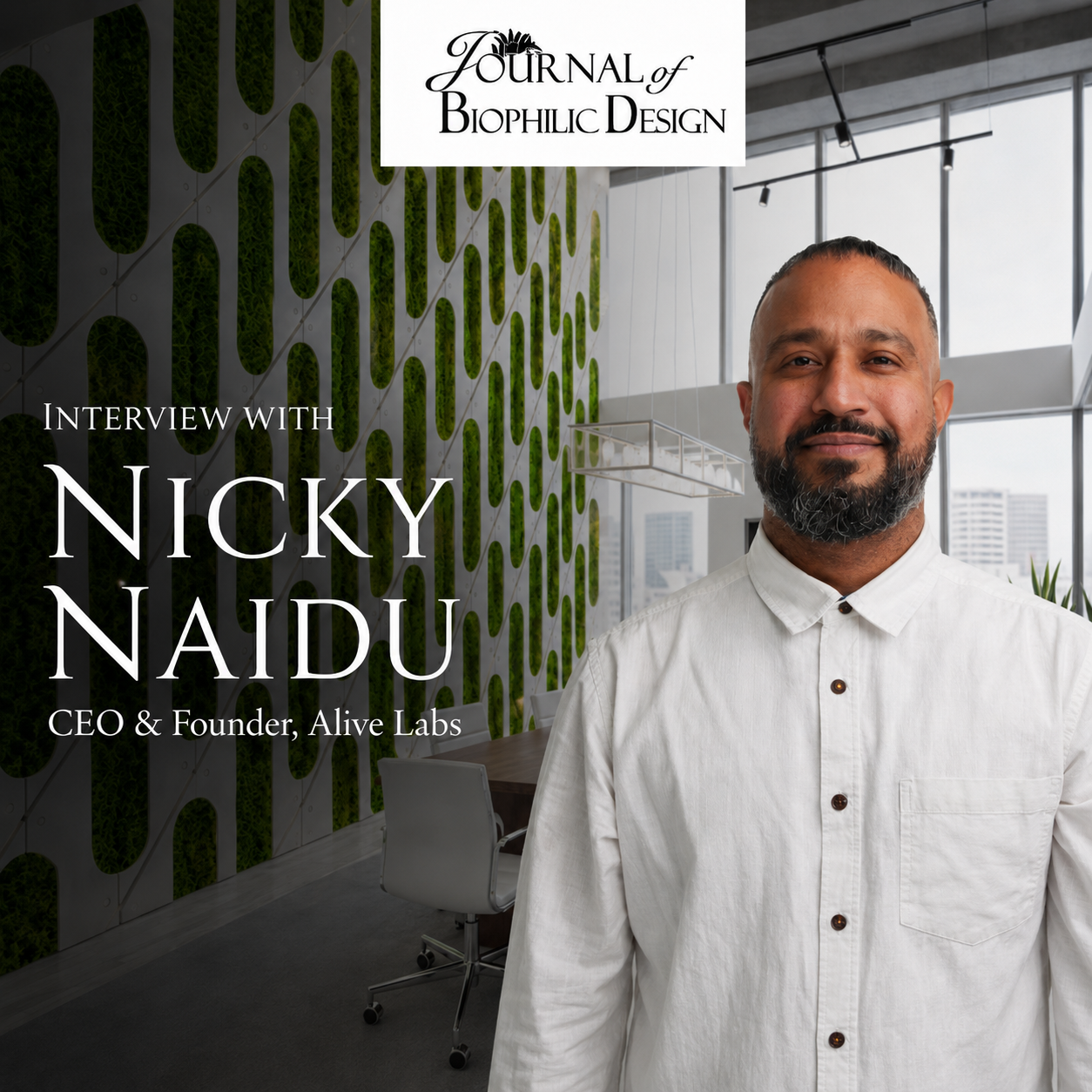
Living Architecture: Bioreceptive Design for People and Planet

Living Architecture: Bioreceptive Design for People and Planet

What if the buildings that help us tackle climate change were also the buildings that lift our spirits?

We talk a great deal about the performance of buildings: how to reduce carbon, manage heat, conserve energy, deal with water and increase biodiversity. But perhaps we need to ask another question. What should these buildings look and feel like?

For architect and Alive Labs founder Nicky Naidu, the answer is not to choose between performance and beauty. We should expect both.

Reconnecting with nature will save our society

Reconnecting with nature will save our society

Sustainability matters, it is a matter of survival. For Carlo Battisti, President at Living Future Europe this is essential. We cannot design or build without considering this.

We already know the solutions, we need to implement them.

Carlo co-founded the Biophilic Society and coordinates LFE biophilic design strategy. “There are so many global issues to solve, our responsibility must start from the built environment, we know that 40% of emissions come from built environment and these have an impact on global issues.”

Each time we build, we start from scratch which means it’s difficult to standardise the processes, also the sector is so slow to change, but the built environment shapes the way we are living.

Carlo tells us about his experience and also about the Living Building challenge framework which was developed in 2006. We are now at the 4th version of the standard which was published in 2019. Biophilic Design has always been a core part of this framework. If we design and build with a better connection to nature, using natural light, better airflow, etc, there will be better energy consumption, greater energy efficiency. Also of course, there are lots of studies which show that bringing sufficient daylight into enclosed spaces, for instance in schools or hospitals, patients recover quicker, students learn faster in classrooms. There is such interesting and robust data.

The Biophilic Summit is taking place on 7th June 2023. The details of the summit programme and how to register can be found here: https://lfeurope.regfox.com/biophilia-summit-2023

Read on…