What if the buildings and places around us could do more than shelter us, accommodate us or help us get from A to B? What if they could actively help us live, work, connect and flourish?
That was the question at the heart of Health, Wealth: Environments That Enrich, an evening hosted by Waugh Thistleton Architects to launch and discuss their new wellbeing research.
Presented by Kirsten Haggart, Associate Director at Waugh Thistleton, the report explores the relationship between the built environment and human wellbeing – asking what we can learn from the spaces in which we spend our lives.
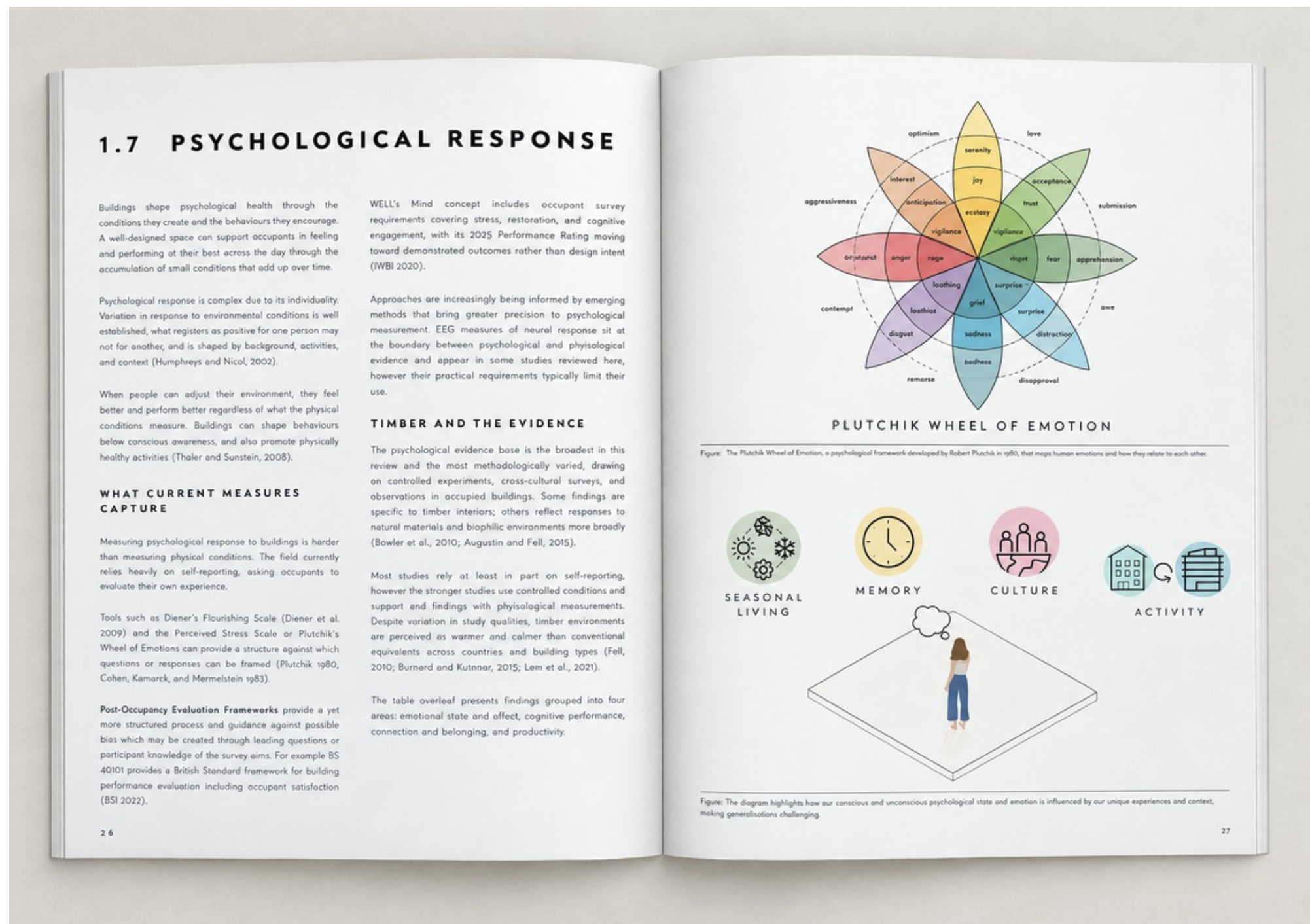
For me, one of the most interesting aspects of the evening was the way the conversation moved beyond the familiar language of “wellbeing features”. Rather than simply adding greenery, daylight or natural materials to a project, the speakers were considering something much bigger: how architecture can create the conditions for people to live better lives.
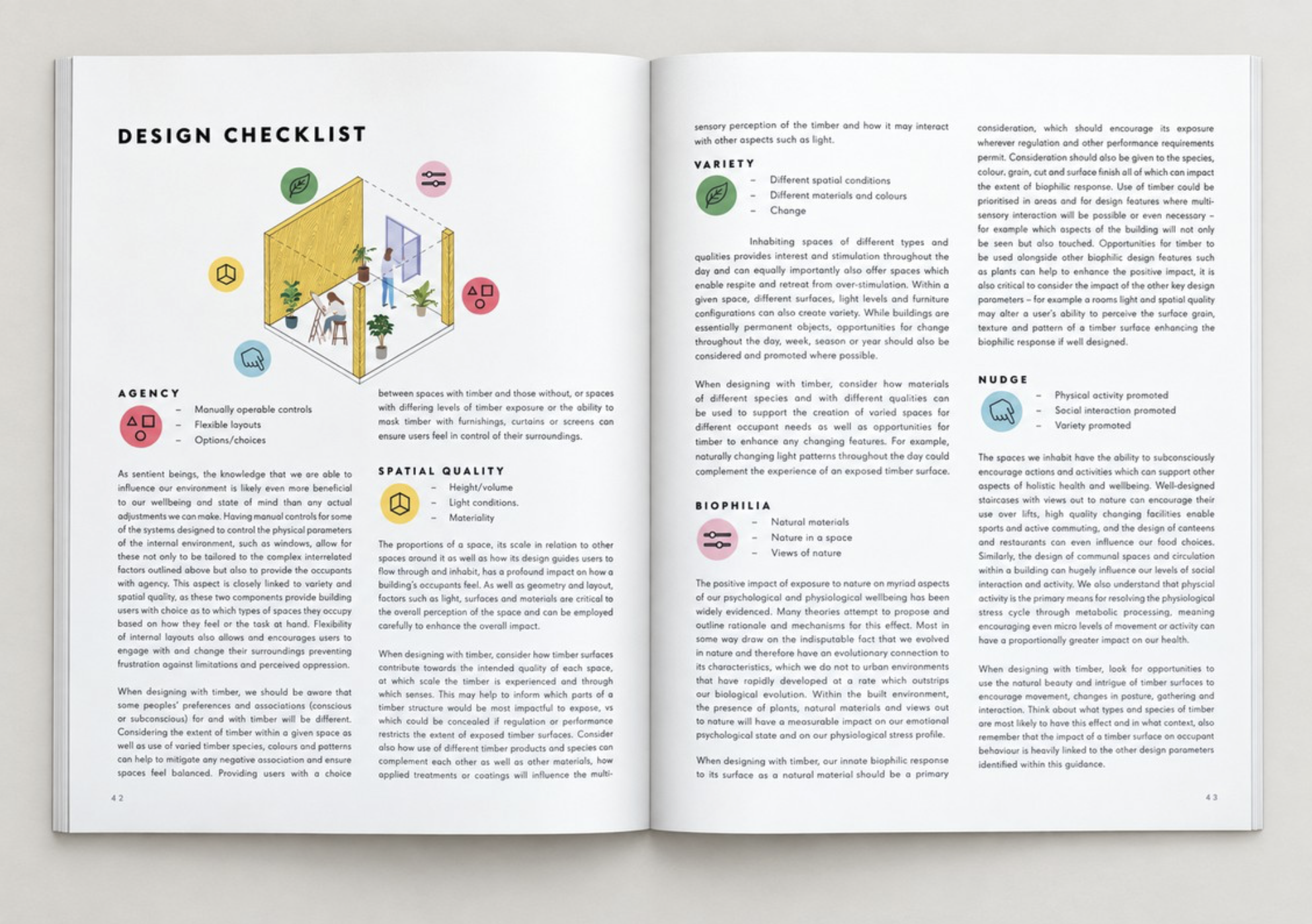
And the research offers a useful way of thinking about this: five interconnected principles – variety, spatial quality, biophilia, agency and nudge.
Think of it as a “five a day” for the built environment.
Designing for how we actually live
Nimi Attanayake Co-Founder of NimTim Architects, spoke about creating homes and spaces that support everyday human experience: access to natural light, opportunities to spend time in green space – both outside and within buildings – social contact and, importantly, agency.
There was also an optimism around the growing openness of home design to biobased and innovative materials.
The Waugh Thistleton research places these considerations within a broader framework. Variety can mean different spatial conditions, materials, colours and opportunities for change. Spatial quality includes height, volume, light and materiality. Biophilia brings in natural materials, nature in space and views of nature. Agency might mean manually operable controls, flexible layouts and genuine choices.
And then there is nudge: designing environments that encourage physical activity, social interaction and variety without dictating how people should use a space.
The framework recognises that people are not passive occupants of buildings.
Building in wood – and building for wellbeing
Anna Ervast Öberg COO, Folkhem, Sweden, a Stockholm-based developer, offered another perspective: that developers and clients have an enormous ability to influence the lives of people through the decisions they make.
Folkhem has built almost 400 homes in wood, working from the principle that the built environment can contribute to a wider bioeconomy while creating places people genuinely want to live.
She asked: what enables people to become the best versions of themselves?
The answer isn’t one-dimensional. Wellbeing comes through multiple sensations and experiences: natural materials, craftsmanship, light, atmosphere and connection to place.
One particularly memorable example was the use of timber as a sensory material. In one project, the timber façade allows the scent of wood to diffuse into the surrounding neighbourhood. Anna described how people instinctively respond: taking a deep breath, touching the walls, relaxing.
These responses aren’t necessarily captured by conventional building metrics, but they are part of our experience of architecture.
There was also an interesting commercial dimension. Anna described how the homes had sold quickly, suggesting that the experience of living in a timber building can translate into real market appeal. Residents were reportedly happy and friendly, with relatively few complaints.
It raises an intriguing question: could wellbeing itself become a form of value in the property market?
From physiological response to psychological experience
Another presentation explored the relationship between the physical and psychological dimensions of the built environment.
The research considers familiar physical parameters such as temperature, air quality, humidity, infection control and light levels, alongside psychological factors including agency, biophilia, variety and visual complexity.
At their intersection sit activity and human interaction.
This is important because the impact of architecture isn’t always something we can easily quantify. The presentation made the point that some of the most meaningful impacts are qualitative.
We might measure air quality or temperature relatively easily. It is harder to put a number on the feeling of entering a beautiful, welcoming space, being able to choose where to sit, encountering a natural material beneath our hand, or having an unexpected opportunity to meet another person.
Yet those experiences are part of how a place works.
The human city
Robert Evans CEO, Wellcome Genome Campus, brought the discussion to the urban scale.
His focus was on improving the lives of people who use King’s Cross and creating an urban environment that supports human activity. His Principles for the Human Cityconsiders how different uses, activities and communities can be layered together.
One observation particularly struck me: workspace and residential buildings may account for much of the occupancy of an area, but you wouldn’t necessarily realise that simply by walking through it.
That is important.
A successful urban place isn’t simply a collection of buildings with different functions. It is an environment in which people can move, meet, linger, work, live and participate.
From buildings to biology
The final presentation brought an entirely different dimension to the discussion, looking at the work being undertaken around Wellcome’s genomics and health research ecosystem in South Cambridge.
With around 2,000 people working within the research environment and scientific progress accelerating at extraordinary speed, the question was asked:
What can we design into a space to help people do their best work?
The emerging vision for South Cambridge is not simply a research campus but something more akin to a small village – incorporating wetlands, nurseries, social spaces and opportunities for community.
There was a recognition that we still rely heavily on proxies and word-of-mouth when trying to understand what makes places successful. Yet the ambition is to gather better data about the relationship between the built environment, human health and behaviour.
And the wider economic context is significant. The Global Wellness Institute valued the global wellness economy at around $5.5 trillion in 2022, with wellness real estate among the sectors experiencing particularly strong growth.
Wellbeing is no longer a niche concern.
A “five a day” for the built environment?
The reiterated takeaway from the evening was that wellbeing doesn’t come from one intervention. It isn’t simply a question of putting plants into an office, increasing daylight, using timber or creating a gym.
The Waugh Thistleton framework brings together five things:
VARIETY – different spatial conditions, materials, colours and opportunities for change.
SPATIAL QUALITY – height, volume, light and materiality.
BIOPHILIA – natural materials, nature in space and views of nature.
AGENCY – flexible layouts, choices and control over aspects of our environment.
NUDGE – environments that encourage movement, social interaction and variety.
Together, these create something more holistic.
And for those of us working in biophilic design, that is particularly interesting. Biophilia doesn’t sit in isolation. It interacts with agency, spatial quality, variety and the ways in which a building encourages us to behave.
Wellbeing as a design principle
Across the evening, very different projects and perspectives kept circling back to the same idea.
Material matters.
Sensory experience matters.
Nature matters.
Social connection matters.
Choice and agency matter.
And the experience of place matters.
The Waugh Thistleton research provides an important contribution to this growing conversation, particularly now when we are all being asked to address not only carbon and energy, but human health and quality of life.
For those of us working in biophilic design, this is an exciting space,. Biophilic Design helps us put human experience – alongside ecological responsibility – much closer to the centre of architectural and all thinking.
To find out more and read the research visit: https://waughthistleton.com/research/