By Dr Vanessa Champion, Founder & Editor the Journal of Biophilic Design
This is not a joke.
In September 2023, the landmark study published in Science Advances delivered a stark assessment of the state of our planet.
In Earth beyond six of nine planetary boundaries, Katherine Richardson, Johan Rockström, Will Steffen and colleagues found that six of the nine planetary boundaries had already been transgressed, placing Earth outside the safe operating space that has characterised the relatively stable conditions of the Holocene. Ocean acidification was also approaching its boundary, while regional aerosol loading had exceeded its boundary.
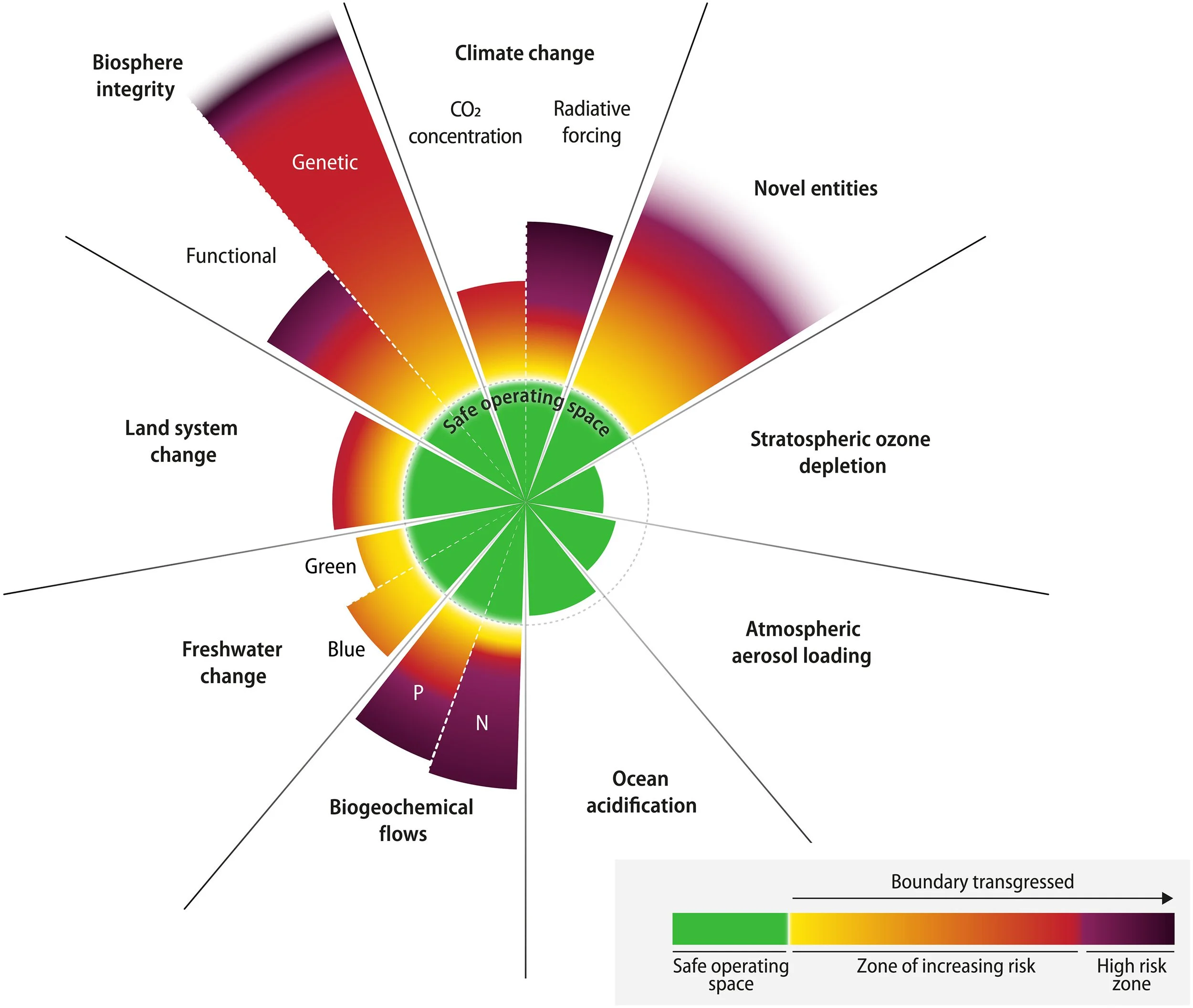
The significance of this research goes beyond a set of alarming numbers. The planetary boundaries framework identifies nine Earth-system processes that are critical to maintaining the stability and resilience of the planet. The research shows that human activity is no longer affecting these systems in isolation. Climate change, land-system change, biosphere integrity, freshwater change, biogeochemical flows and novel entities interact with one another, creating increasingly complex risks to the systems that support life.
Buildings, cities, infrastructure and the products we manufacture are not separate from these planetary systems. They are embedded within them. Every material we extract, every landscape we transform, every building we construct, every litre of water we consume and every product we manufacture has a relationship with the living systems around us.
For too long, sustainability has often been framed primarily as a question of reducing harm: use less energy, emit less carbon, consume fewer resources and produce less waste. These remain essential. But the planetary-boundaries research tells us that we need to think more systemically.
This is where Biophilic Design becomes increasingly important.
Biophilic Design brings our relationship with the living world into the decisions we make about buildings, places, materials and infrastructure. It connects people with natural light, air, water, vegetation, biodiversity, natural materials, patterns and processes. It recognises that the built environment sits within, rather than outside, the natural world.
And that principle needs to move upstream.
I will continue to advocate that Biophilic Design needs to be woven into policy, planning, procurement, manufacturing, architecture, landscape design, engineering and product specification. Biophilic Design needs to influence the brief before the building is designed, the material before it is specified and the product before it enters the supply chain.
When we choose a material, we should ask where it came from, what ecosystems were affected by its extraction, how much energy and water were required to produce it, and what happens when its useful life ends. When we design a building, we should ask how it can work with daylight, air, water, vegetation and local climate. We should ask whether our buildings can provide habitat, retain rainwater, support biodiversity, reduce resource consumption and reconnect people with the living systems on which we depend.
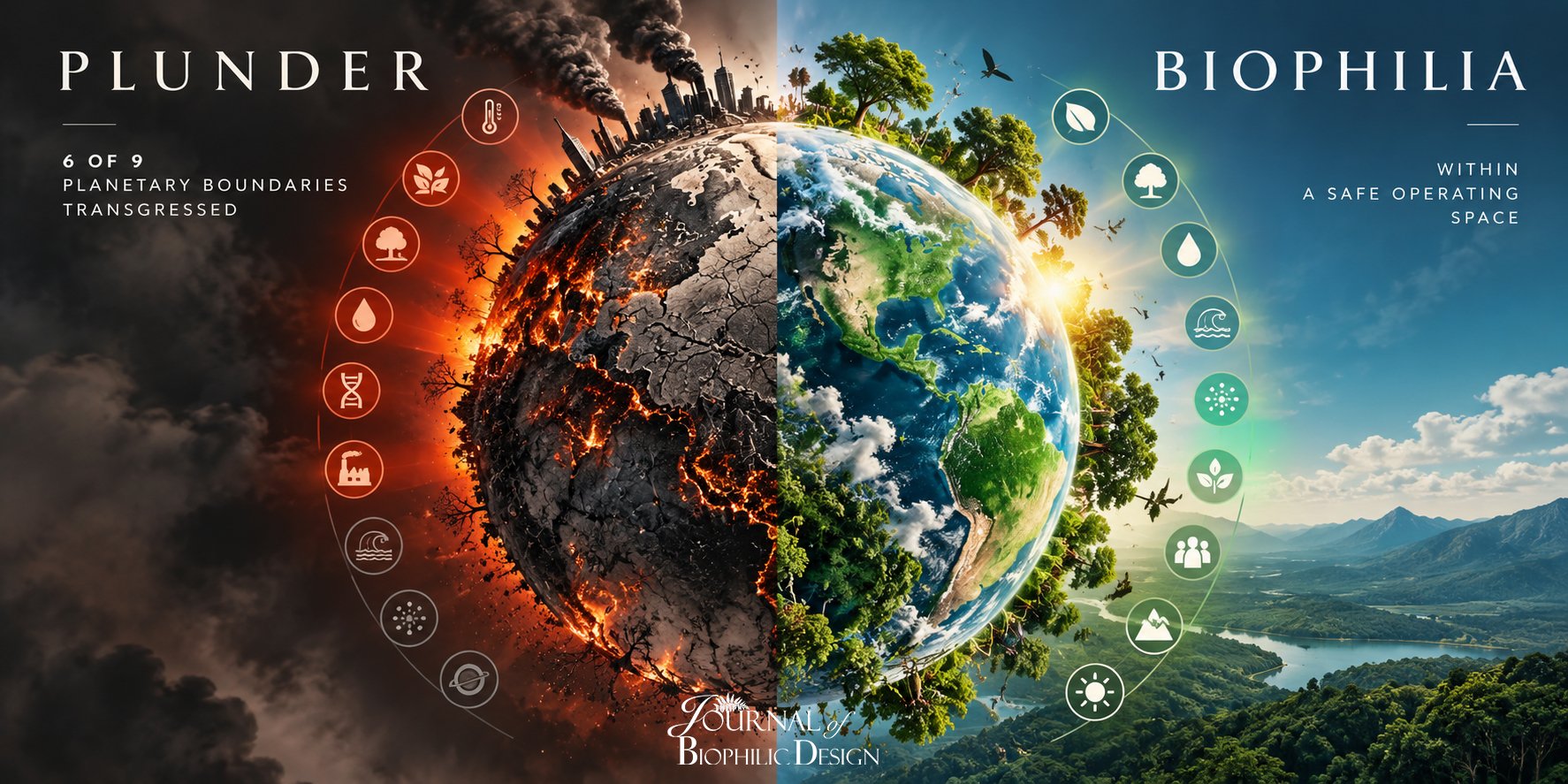
This is the Biophilic hypothesis in action: every decision we make about the built environment becomes a decision about our relationship with life.
If a decision damages the systems that support life, we should find another way. If it supports life, restores ecosystems, reduces resource consumption or strengthens our relationship with nature, we should do more of it.
Six of nine planetary boundaries have already been transgressed, it is increasingly urgent.
The planetary boundaries research gives us the scientific evidence that we have moved beyond the safe operating space. Biophilic Design gives us a way to bring that knowledge into the places where decisions are made — from policy and planning to manufacturing, architecture and everyday specification. We cannot treat the built environment as separate from the planet. We just cannot. It is madness to do the opposite and carry on as we are. Madness.
We build within living systems. We manufacture within living systems. We live within living systems. Our future depends on designing with all life at the forefront of our decision making. A Biophilic Design framework helps us all do that.
Reference: Richardson, K., Steffen, W., Lucht, W., et al. (2023). Earth beyond six of nine planetary boundaries. Science Advances, 9(37), eadh2458.
DOI: 10.1126/sciadv.adh2458 The illustration from the article.