By Dr Vanessa Champion, founder/ editor Journal of Biophilic Design
Today, the 14 October 2026, the publication of The 2026 State of the Climate Report: Challenges and Opportunities has brought a stark assessment of the planet’s condition into focus. Published in BioScience by an international group of climate scientists[1], the report updates 16 indicators of the state of the climate system and the human activities driving change. Seven of those indicators are at record extremes, while several others show signs of acceleration or abrupt shifts.

I attended a briefing on the report today hosted by the Strategic Climate Risks Initiative, on Managing Risk As We Enter Overshoot, where scientists and policy experts considered what these findings mean for the coming year, for national and international security, and for the decisions required to manage a world approaching or exceeding critical climate thresholds.[2]
The message emerging from the report and discussion is that the situation is serious. The scientific understanding must now translate into decisions, investment and implementation at a scale commensurate with the risks.
For those of us working in the built environment we need to address right now, how can the places in which we live, work, learn and receive care become part of the response, rather than perpetuating the systems that have brought us to this point?
“I believe that the answer must include a more fundamental reconsideration of our relationship with nature. Biophilic Design is not a substitute for decarbonisation, climate policy or ecological protection. But, understood through the biophilia hypothesis, it can provide an overarching framework for bringing these priorities together around a shared purpose: designing for life.”
The planet’s vital signs
The 2026 report presents evidence of mounting pressure across the atmosphere, oceans, ice sheets and biosphere. Atmospheric concentrations of carbon dioxide, methane and nitrous oxide all reached record levels again in 2026.
Carbon dioxide exceeded 428 parts per million in May, approximately 50% above pre-industrial levels.
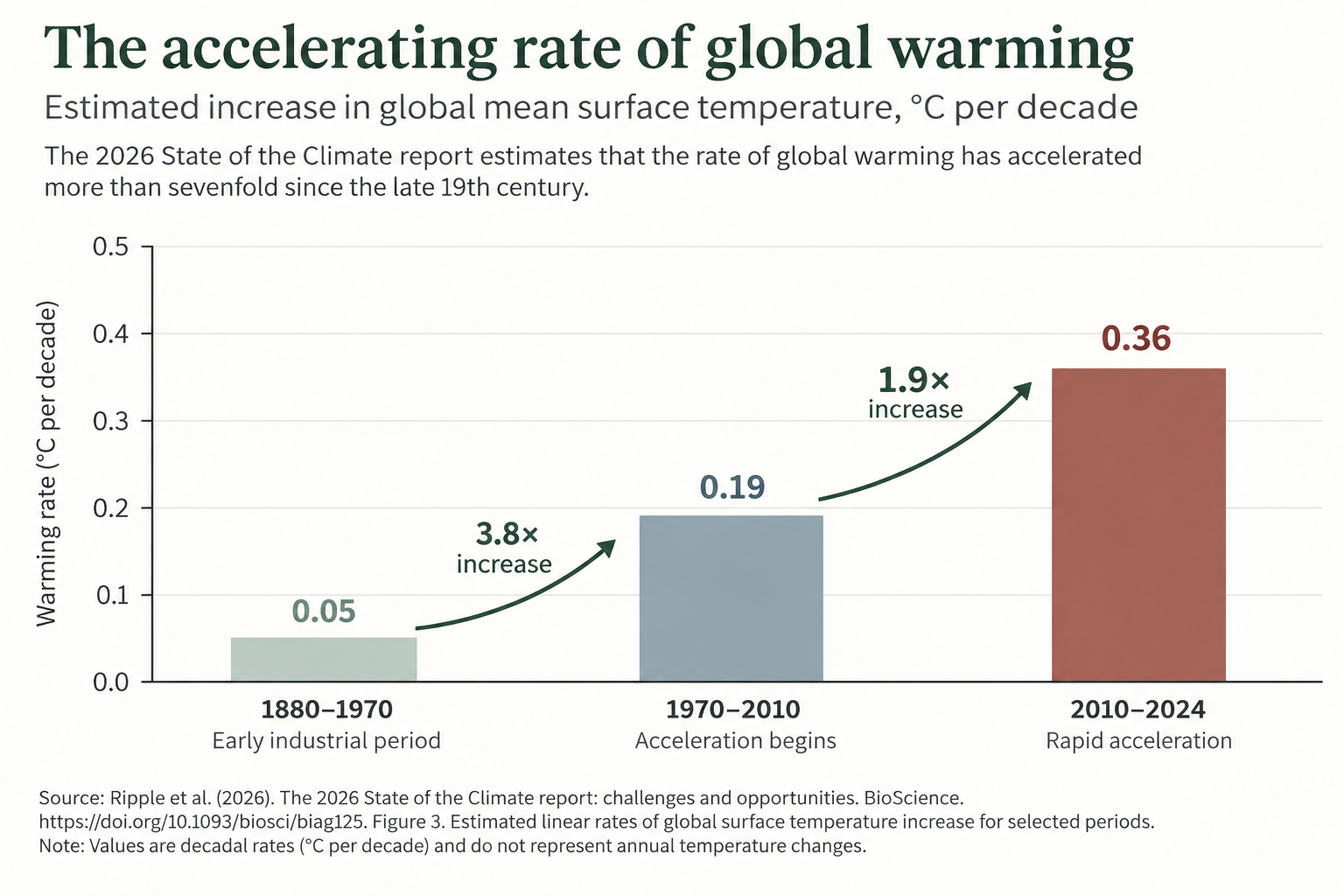
The report also identifies a marked acceleration in the rate of global warming.
Its analysis estimates a rise of approximately 0.05°C per decade between 1880 and 1970, 0.19°C per decade between 1970 and 2010, and 0.36°C per decade between 2010 and 2024. The authors note that the reasons for the recent acceleration remain an area of scientific investigation, with factors including changes in atmospheric aerosols, ocean circulation and the behaviour of natural carbon sinks under scrutiny.
Earth’s energy imbalance is another critical indicator. This measures the difference between the energy the planet absorbs from the Sun and the energy it radiates back into space. When more energy enters than leaves, heat accumulates throughout the climate system. The consequences include warming oceans, rising sea levels, melting ice and increasing pressure on ecosystems.
The report records ocean heat content and sea level at record highs, alongside record-low glacier thickness and Greenland ice mass. It also highlights the growing contribution of wildfires to climate disruption. Global tree-cover loss due to fires reached 10.8 million hectares in 2025, the third-highest level on record. Fires release greenhouse gases, damage ecosystems and can further weaken the natural systems that absorb carbon.

These indicators are interconnected. Forest degradation, rising temperatures, changing rainfall and weakening carbon sinks can reinforce one another. The concern is not only that individual hazards are becoming more severe, but that changes in one part of the Earth system may intensify pressures elsewhere.
The report identifies several possible feedbacks and tipping risks, including those involving the Amazon rainforest, the Atlantic Meridional Overturning Circulation (AMOC), ice sheets and permafrost. The timing and likelihood of individual tipping events remain uncertain, but uncertainty is not a justification for inaction when the potential consequences are profound.
“This is the central challenge of climate risk management: decisions must be made before every outcome is known, because waiting for complete certainty may mean losing the opportunity to prevent irreversible damage.”

Overshoot - managing the risk without surrendering the ambition
The briefing considered what it means to enter a period of climate overshoot: temporarily exceeding a temperature threshold such as 1.5°C above pre-industrial levels. Exceeding a temperature threshold does not mean every climate objective becomes unattainable, nor does it remove the value of reducing emissions. It’s that the duration and extent of overshoot matter, as do the risks of triggering changes that may be difficult or impossible to reverse on human timescales. The meeting highlighted tropical coral reefs, the Amazon basin, Arctic systems, the Greenland and West Antarctic ice sheets, and permafrost among the systems of particular concern. They also recorded discussion of the potential for a severe weakening or shutdown of the AMOC, the ocean circulation system that transports heat around the Atlantic.
“These risks reinforce the need to reduce the duration and magnitude of any overshoot while preparing communities for the changes already under way.
Adaptation and mitigation must therefore proceed together. Mitigation reduces the causes of climate change; adaptation reduces exposure and vulnerability to its consequences. Neither can replace the other.”
For architects, developers, planners, engineers and designers, this means considering not just the emissions associated with constructing and operating a building, but also how that building performs during extreme heat, flooding, drought, power disruption and changing patterns of occupancy. It means planning for resilience without losing sight of the urgent need to reduce emissions.
“It also means recognising that a building does not exist in isolation. Its resilience depends on the surrounding landscape, drainage systems, energy infrastructure, transport networks, food supply and the health of the ecosystems on which the community depends. A climate-resilient building in a climate-vulnerable neighbourhood is not, on its own, a resilient settlement. The scale of our thinking must expand from individual buildings to streets, neighbourhoods, cities, regions and the wider living systems that sustain them.”
Energy security and the politics of transition
One of the most striking contradictions in the report is that the growth of renewable energy has not yet displaced fossil fuels at the rate required.
Fossil fuel consumption increased by 0.9% in 2025, with oil, coal and gas all reaching record highs. Energy-related carbon dioxide emissions exceeded 41 billion tonnes for the first time. At the same time, solar and wind energy consumption grew by approximately 18%.
There are encouraging developments. The report estimates that low-carbon sources supplied around 43% of global electricity generation in 2025. It also notes that, in 2025, renewable sources overtook coal in global electricity generation for the first time in more than a century of coal-dominated electricity production.
Yet the growth in clean energy has not been sufficient to displace fossil fuels across the wider energy system. Rising demand has allowed both renewable generation and fossil fuel consumption to increase.
The geopolitical implications are substantial. The report describes how conflicts and international tensions have exposed the vulnerability of energy systems dependent on fossil fuel supply chains. Disruptions and price volatility can make domestic renewable energy, electrification and storage more attractive, not only as climate measures but also as strategies for energy security.
This creates an opportunity to align climate mitigation with national resilience. However, geopolitical tensions can also weaken international cooperation and divert resources towards conflict.
The briefing raised the need to move beyond zero-sum geopolitical thinking and develop governance systems capable of addressing shared systemic risks. It also highlighted proposals for clearer limits on new fossil fuel infrastructure investment, stronger carbon-pricing mechanisms, and a fairer distribution of technology and adaptation finance.
“For the built environment, energy security must become a design consideration. Better building envelopes, passive cooling, daylight optimisation, efficient heat pumps, renewable electricity and storage can reduce demand and improve resilience. Distributed energy systems can also help communities withstand disruption to centralised grids.”
These measures must be evaluated in context. A green-looking building is not necessarily a low-carbon building, and adding technology does not automatically produce sustainability.
“Whole-life carbon, operational energy, material sourcing, biodiversity impacts and the performance of the building over time all matter.
Biophilic Design can help connect these technical decisions to a broader objective: creating places that support human life while reducing pressure on the ecological systems on which that life depends.”

The built environment: from carbon reduction to designing for life
Buildings and infrastructure sit at the intersection of climate mitigation, adaptation, human health and ecological change. They consume energy and materials, influence transport and land use, shape exposure to heat and flooding, and determine how much room is left for nature within our settlements.
The opportunity is to stop treating these issues as separate design briefs. A building might meet an energy-efficiency target while contributing to habitat loss. A highly insulated building might still overheat if it lacks appropriate shading and ventilation. A landscaped development might look green while relying on thirsty planting, sealed surfaces and poor ecological connectivity. A flood defence might protect one site while transferring risk elsewhere.
A more integrated approach asks how each intervention performs across the whole system: does it reduce emissions, protect biodiversity, conserve water, improve resilience and support human wellbeing?
This is where Biophilic Design has a particularly valuable contribution to make.
Biophilic Design is often understood through its visible features: planting, living walls, natural materials, daylight, views of greenery and access to outdoor spaces. These are important, but the discipline can be understood more deeply than a collection of aesthetic interventions.
The biophilia hypothesis, associated with the work of Erich Fromm and developed influentially by biologist E.O. Wilson, proposes that humans have an innate tendency to affiliate with other forms of life and natural processes.
Biophilia invites us to consider what happens when our buildings and cities are designed around a fundamental human relationship with the living world, rather than treating nature as an optional amenity.
This distinction matters in a climate emergency. If we understand nature as essential to human flourishing, ecological protection becomes more than a planning constraint or corporate sustainability objective. It becomes part of the purpose of design itself.
The hypothesis does not, on its own, provide a quantified climate mitigation strategy. Nor does it mean that every biophilic intervention reduces carbon emissions. Its potential lies in offering an overarching philosophy that can bring together evidence-based decisions about materials, energy, ecology, human experience and long-term stewardship.
Biophilic principles as a practical climate framework
Many established Biophilic Design approaches can be translated into practical actions for the built environment.

The following connections are just three examples I suggest for the application of biophilic thinking to the challenges identified in the 2026 report, rather than a framework explicitly prescribed by its authors.
1. Nature in the space - using living systems to reduce risk.
Trees, wetlands, green roofs, rain gardens, planted courtyards and connected green corridors can help make settlements more resilient. Urban trees provide shade and can reduce local heat exposure. Wetlands and floodplains can store water. Permeable surfaces can reduce runoff, while vegetation can support biodiversity and improve the experience of public space.
These interventions connect directly with the report's fast-track adaptation measures, which include urban trees and reflective roofs for extreme heat, wetlands and permeable surfaces for flooding, and ecosystem restoration for wider climate resilience.
The design question should be which living systems are appropriate to the site, what ecological functions they perform, how will they be maintained, and whether they strengthen the wider landscape.
2. Reducing whole-life impacts with Natural materials and processes
Natural materials can help establish a tangible connection with the living world, but their environmental performance must be assessed rather than assumed. Timber, stone, wool, bio-based materials and other material choices should be considered in terms of embodied carbon, durability, toxicity, biodiversity impacts, responsible sourcing, repairability and end-of-life options.
Reuse and retrofit must also be considered before demolition and rebuilding. Extending the life of existing structures can avoid some of the emissions associated with new materials and construction, although the best option depends on the building's condition, future use and whole-life performance.
The biophilic principle is to work with material and ecological processes intelligently, rather than to equate a natural appearance with sustainability.
3. Designing for changing conditions by maximising on the nature in the space.
Biophilic Design explores how people experience prospect, refuge, shelter, mystery and spatial variation. These ideas can inform buildings that offer comfort, orientation and a sense of security while responding to environmental conditions.
Shading, natural ventilation where appropriate, sheltered outdoor areas, views of vegetation and access to cooler spaces can contribute to heat adaptation. Courtyards and green spaces can be designed as usable refuges during hot weather, while building orientation, solar control and appropriate thermal performance help manage energy demand.
Such measures must be integrated with building physics and local climate conditions. Natural ventilation is not suitable in every circumstance, and vegetation alone cannot prevent dangerous indoor temperatures. The aim is to combine passive design, efficient systems and nature-positive planning rather than relying on any single intervention.
4. Natural light, sensory connection and human wellbeing.
Daylight, changing patterns of light, views of nature, natural sounds and seasonal variation can strengthen people's experience of place. Research on biophilic environments has examined associations with stress, attention, mood and wellbeing, although outcomes vary with the intervention, population and setting.
These human benefits matter because climate action must also create places people want to inhabit and care for. Schools, workplaces, hospitals, care settings and homes can make nature accessible in everyday life, including for people who cannot easily reach parks or countryside.
The goal should be to combine measurable environmental performance with meaningful human experience, not to use wellbeing as a substitute for measuring carbon or ecological outcomes.
5. Ecological connection and designing beyond the site boundary.
Perhaps the most important application is to move from isolated green features towards connected living systems. Buildings and public spaces can support habitat networks, native planting, soil health, water cycles and urban biodiversity.
The report warns that climate change and biodiversity loss interact, and that natural carbon sinks cannot be assumed to remain stable under increasing pressure. Protecting existing ecosystems, restoring degraded habitats and avoiding unnecessary land conversion must therefore be central to development decisions.
A planted roof cannot compensate automatically for the destruction of a mature habitat. Nor should a living wall become a justification for removing trees or sealing soil elsewhere. Biophilic thinking is most useful when it encourages designers to consider the integrity of the whole ecosystem.
Adaptation and mitigation must work together
One of the report's most important contributions is its insistence that reducing emissions is no longer sufficient on its own. Communities must also prepare for the impacts already unfolding.
The report estimates global climate adaptation finance at approximately US$64 billion in 2024, far below the estimated US$310–365 billion per year that developing countries alone will require by 2035. It also highlights the uneven distribution of finance and the barriers facing local and frontline communities.
This is a question of justice as well as engineering. Those least responsible for historical emissions often have the least capacity to adapt.
In the built environment, adaptation must mean more than protecting high-value developments. It must include affordable, healthy homes; access to shade and cooling; reliable water and energy; safe public spaces; and infrastructure designed around the needs of vulnerable communities.

Nature-based solutions can contribute to both adaptation and mitigation. Urban forests can help moderate heat while storing carbon. Wetlands can support flood management and biodiversity. Mangroves can protect coastlines while maintaining important carbon stores. However, the effectiveness of adaptation measures may decline as warming increases, making rapid emissions reductions indispensable.
The report's central lesson is therefore one of integration. A successful climate response should seek multiple benefits wherever possible, while being honest about trade-offs and limits. So designers, should be applying the biophilia principle, is it to the detriment of life or for the benefit of living systems? Does it protect, restore, improve and how does it perform as climate conditions change?
Reconnecting people with agency
The briefing also addressed a less visible but essential dimension of climate risk: the possibility that worsening consequences will overwhelm societies, undermine confidence and distract attention from the causes of the crisis.
We also need to protect people's capacity to act, even during overshoot. They also highlighted the need to communicate scientific uncertainty more clearly, link abstract indicators to visible events, and strengthen participation in climate solutions.
This is an area where the biophilia hypothesis offers a useful perspective. People do not experience climate change through graphs alone. They experience it through heat in their homes, flooded streets, lost trees, disrupted food supplies, damaged landscapes and the disappearance of familiar species.
Equally, people encounter the possibility of change through restored habitats, cooler streets, thriving gardens, accessible parks and buildings that make nature part of daily life.
These experiences cannot replace scientific evidence or policy. But they can help make environmental change tangible and strengthen the connection between individual lives and the wider systems on which they depend.
Biophilic environments should not be presented as a cure for climate anxiety, nor should responsibility be shifted from governments and major emitters onto individuals.
But we should be consciously creating more and more places that support health, community, participation and a sense of agency while delivering measurable environmental improvements.
Education is central to this. Schools, universities, workplaces and public institutions can make the relationship between climate, biodiversity, materials, energy and human wellbeing visible. Biophilic Design can help turn buildings into places where the principles of ecological interdependence are experienced as well as taught.

Moving beyond incremental improvement
The report argues that incremental adjustments will not be sufficient to stabilise the climate system. Transformation is required across energy, consumption, food systems, economic priorities and governance.
The scale of the energy challenge makes this clear. The report notes that despite the rapid growth of renewables, fossil fuel use and emissions continued to rise. A transition that adds clean energy without sufficiently reducing fossil fuel dependence cannot deliver the required reductions on its own.
We need to cut methane and other short-lived climate forcers, changing food systems, investing in technologies that provide multiple benefits, and examining emerging interventions responsibly. Heat pumps, for example, can provide both heating and cooling, while distributed solar and battery storage can support energy security and reduce exposure to grid disruption.
The report also points to the emergence of positive social tipping points: changes in technology, policy, finance or behaviour that can trigger wider transformations. Falling renewable energy costs, expanding electrification and growing interest in ecosystem restoration offer grounds for action, even though the overall pace remains inadequate.
For the built environment, transformative change means questioning the assumptions behind development itself. Can existing buildings be reused rather than replaced? Can neighbourhoods be planned around walking, cycling, public transport and accessible green space? Can material supply chains support circularity and ecological restoration? Can energy demand be reduced before new generation capacity is added? Can urban development restore the living systems it depends upon?
Biophilic Design implementation can help guide the direction of investment, regulation and professional practice.
Biophilic Design can provide a unifying language for these decisions, but it must be tied to clear targets, evidence and accountability. Nature-positive intentions need to translate into lower emissions, better adaptation, stronger biodiversity outcomes and healthier places.
What needs to happen now?
The report's authors conclude that rapid emissions reductions, effective adaptation, ecosystem protection and transformative societal change remain essential. The briefing brought that conclusion into the policy arena, where the challenge is to turn evidence into decisions before risks become more difficult to manage.
For the built environment, a practical action agenda should include the following priorities.
First, make climate performance a core design requirement. Assess operational energy, whole-life carbon, water, biodiversity and resilience together from the earliest stages of a project. Avoid treating planting or green finishes as evidence of sustainability without measuring outcomes.
Second, prioritise retrofit, reuse and demand reduction. Improve the performance of existing buildings, reduce unnecessary demolition and construction, and combine passive design with efficient electrification and renewable energy where appropriate.
Third, design with living systems. Protect existing trees, soils and habitats; restore ecological connections; use appropriate nature-based solutions for heat and flood risk; and provide equitable access to green space.
Fourth, prepare for climate impacts already under way. Incorporate heat-risk assessments, flood management, water security, resilient infrastructure and emergency planning into buildings and neighbourhoods. Design for the most vulnerable users, not just average conditions.
Fifth, connect biophilic principles to measurable outcomes. Evaluate whether projects reduce energy demand, avoid emissions, support biodiversity, improve thermal comfort and deliver meaningful access to nature. Use post-occupancy evaluation and long-term monitoring to learn what works.
Sixth, align investment and policy with the science. Planning frameworks, procurement, finance and building regulations should reward genuine emissions reductions and ecological restoration. Climate adaptation funding must reach communities with the greatest needs, including those with limited resources to protect themselves.
Seventh, make education and participation part of delivery. Give occupants, communities, designers and decision-makers the knowledge and means to act. Share evidence, communicate uncertainty honestly and demonstrate the benefits of solutions in the places where people live.
None of these actions is sufficient in isolation. Together, they can help connect the building scale to the larger transitions required across energy, land use, infrastructure and society.
Designing for life

The 2026 State of the Climate Report describes a planet under increasing strain, but it also identifies opportunities for meaningful change. Renewable energy, storage, ecosystem restoration, adaptation planning and new approaches to climate risk management show that the future remains open to influence.
The urgency lies in the gap between what is technically possible and what is being implemented.
Biophilic Design cannot reverse the climate crisis by itself. It cannot replace rapid decarbonisation, binding policy, adequate finance or international cooperation. But it can help us reconsider the purpose of the built environment and the relationship between human prosperity and the living world.
The Biophilia Hypothesis asks us to take our connection with other forms of life seriously.
Applied to design, that idea can help shape buildings and cities that conserve resources, protect ecosystems, support human wellbeing and build resilience to the changes already occurring.
The next step is to make this philosophy operational: connect it to carbon budgets, ecological targets, adaptation plans, procurement decisions and the everyday choices of the people who shape our built environment.
As we approach COP31, everyone I speak to in the build and design community acknowledges the planet's failing vital signs. Together as an industry, we hold in our hands the keys to respond to them in every design and build we are involved in.
Let’s do this.
Join the conversation at: www.journalofbiophilicdesign.com
The future is something we build together. Let's make it a future that works for people and planet. The world of biophilic design delivered to you – join us: https://mailchi.mp/journalofbiophilicdesign.com/50-free-subscription-promotion
What is Biophilic Design? https://journalofbiophilicdesign.com/what-is-biophilic-design
Want a free copy of the Journal? Visit: https://journalofbiophilicdesign.com/free-materials-issue
Thank you to the illustrators: Karacis Studio, Isaanu Studio, Beatriz Camaleão, Yeti Iglesias, Erone Stuff, Eva Wahyuni, Summertime Flag and Mihad.
[1] Ripple,W.J., Wolff,C., Mann, M.E., et al, BioScience, 2026,0,biag125 https://doi.org/10.1093/biosci/biag125
[2] Panellists included: Piers Forster, Priestley Centre for Climate Futures, University of Leeds; UK Climate Change Committee, Inés Camilloni, University of Buenos Aires and CONICET; Vice-Chair, IPCC Working Group I, Baroness Bryony Worthington, lead author of the Climate Change Act 2008 and Laurie Laybourn, Executive Director, Strategic Climate Risks Initiative.