If you've found yourself feeling more irritable during the recent heatwaves, you're not imagining it. A recent Guardian article explored the growing body of research showing that high temperatures affect far more than our physical comfort. Heat places the body under stress, disrupting sleep, increasing fatigue and dehydration, making us less patient, less focused and more prone to conflict. Studies have even linked hotter days with increases in aggression, road rage and mental health emergencies.
This is precisely why Biophilic Design needs to become central to the way we design our towns and cities. As temperatures continue to rise, we cannot rely solely on air conditioning and mechanical cooling. We need places that work with nature to create healthier, cooler and more resilient environments.
Too often, trees, planting and water are still treated as aesthetic additions once the buildings have been designed. They are not decorative extras; they are vital infrastructure for public health and climate adaptation.
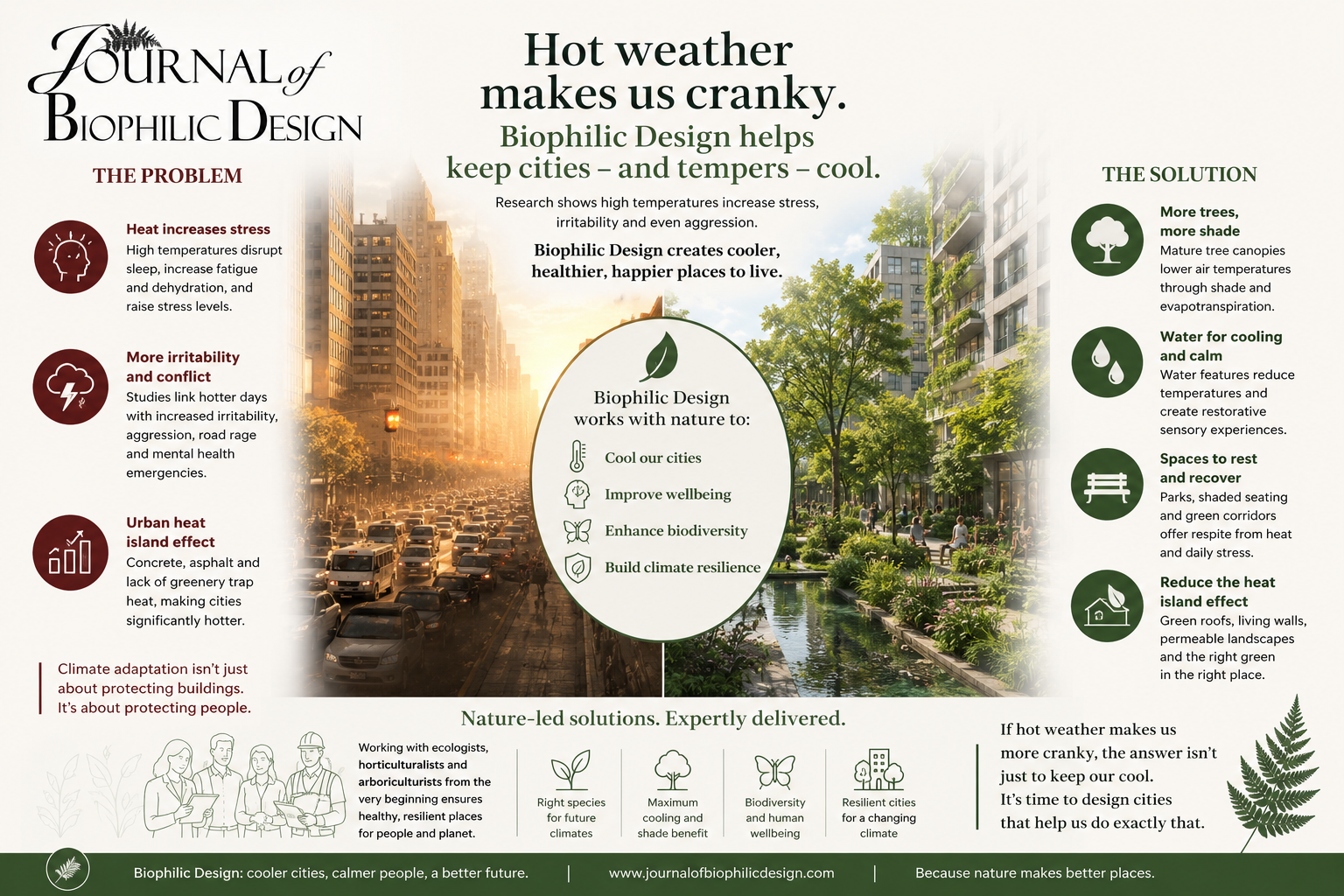
Biophilic Design offers practical, evidence-based solutions to reduce the urban heat island effect while creating places where people can recover from the psychological and physiological stress of extreme temperatures. A mature tree canopy can significantly lower surface and air temperatures through shade and evapotranspiration. Green roofs, living walls, permeable landscapes and thoughtfully designed planting all contribute to cooling our towns and cities. Water features, where appropriate, can further reduce temperatures while providing restorative sensory experiences that help calm the nervous system.
Equally important are the spaces between buildings. Pocket parks, shaded seating, green corridors and accessible places of refuge from the sun allow people to pause, cool down and reconnect with nature during increasingly frequent periods of extreme heat. These spaces are not luxuries; they are becoming an essential part of climate resilience.
The challenge is that these solutions cannot be delivered by architects alone. Creating genuinely resilient places requires collaboration between architects, landscape architects, ecologists, horticulturalists and arboriculturists from the very beginning of every project. Understanding which species will thrive in future climates, where trees will have the greatest cooling effect, and how biodiversity can be enhanced alongside human wellbeing requires specialist expertise.
Climate adaptation is not just about protecting buildings; it is about protecting people.
The encouraging news is that the solutions already exist. The same biophilic interventions that cool our streets also improve biodiversity, air quality, physical health and mental wellbeing. They make cities more beautiful, more liveable and more resilient.
If hot weather really does make us more cranky, perhaps the answer isn't to tell people to keep their cool. It's time we embraced Biophilic Design to create cities that help us do exactly that.
Dr Vanessa Champion, Founder & Editor, Journal of Biophilic Design
The Guardian article referred to in this piece: https://www.theguardian.com/wellness/2026/jul/09/why-hot-weather-affects-mood?