Report by Zoé Lay, Editorial Assistant, Journal of Biophilic Design
On Monday 20th July, 5 women leading the charge in Biophilic Design across continents came together to talk about Biophilic Design, their journey’s into it and community. It is the first of a series.
The Women in Biophilic Design panel brought together five women working across design, education, publishing, environmental psychology, forest therapy and community building.
Although their routes into the field were very different, each had come to biophilic design through a personal experience of healing, stress, nature connection or the feeling that conventional design practice was missing something fundamental.
The conversation went beyond the usual discussion of plants, materials and visual references to nature. It became a broader discussion about what biophilic design can bring back into practice, including more care, better listening, stronger collaboration, a deeper sense of place and greater responsibility for the people and generations who come after us.
What stayed with me most was the sense of hope running through the discussion. The panellists did not deny the scale of the environmental and social challenges we face. Instead, they suggested that many of the qualities needed to respond to them already exist within the field and within the communities forming around it.
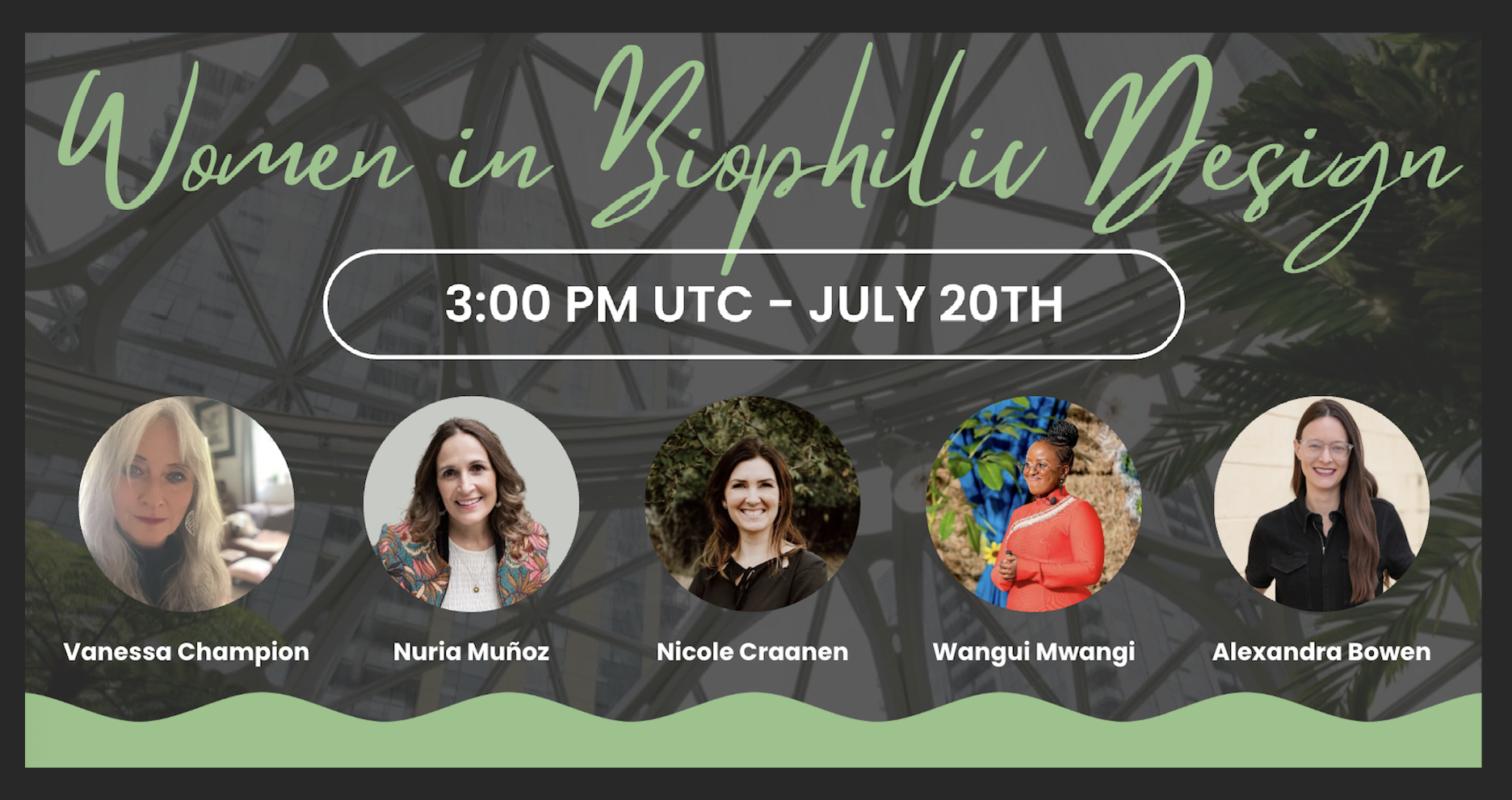
Panellists
Alexandra Bowen · Host
Founder, Biophilic Design Community on LinkedIn
Alexandra’s work focuses on our biological need for nature and on helping people rediscover awe and wonder in everyday life.
Born in Hawaii, she described experiencing a form of “green withdrawal” after moving to the mainland for high school. In Hawaii, nature has always been part of daily life. After moving, it became somewhere she had to make a deliberate effort to visit.
This experience shaped her conviction that nature is not a luxury. It is a biological imperative and should be embedded within the places we inhabit.
Wangui Mwangi
Founder, Green Biophilic Living Society · Convener, Africa Biophilic Building Conference & Expo 2026
Wangui is an interior designer and artist who champions culturally rooted, regenerative design.
She described discovering the term biophilia during a stressful period early in her professional life. Regular walks in nature made her feel noticeably better, leading her to question why that happened and eventually to the wider field of biophilic design.
Her contribution significantly reframed the conversation by reminding the panel that biophilic living is not new to Africa:
“Africa has always lived biophilically. Our ancestors have always lived biophilically. They just didn’t have the word biophilia.”
For Wangui, the challenge is not to import a new design trend into Africa. It is to recognise, document and strengthen practices that already exist, and to anchor them within data, education and policy.
Nuria Muñoz
Leader, Habitarmonia Academy · Environmental Psychologist
Nuria works across environmental psychology, somatic reflection, education and neuroscience-backed design frameworks. She described herself through several interconnected roles: mentor, educator, systems thinker and a “weaver” who brings people and ideas together.
She grew up in the Basque Country surrounded by mountains, plants, drawing and her father’s interior design practice. Nature and design were therefore closely connected from an early age.
Later, while working in fashion and retail, she became increasingly aware that many environments were designed primarily to encourage consumption. Discovering biophilia offered a way to reconnect design with purpose.
Dr Vanessa Champion
Founder and Editor, Journal of Biophilic Design
Vanessa works to bridge the gap between academic research and practical design. Through the Journal of Biophilic Design, its podcast, events and wider campaigning, she makes evidence and case studies accessible to designers, architects, organisations and project decision-makers.
Her relationship with nature began early through her mother’s interest in ecology, her own creative practice and time spent outdoors. She works across painting, drawing, photography and sculpture, often using nature as both subject and material inspiration.
A particularly personal motivation came from her father’s experience with Alzheimer’s. It reinforced her determination that hospitals, schools, workplaces and care environments should not be designed as lifeless white boxes.
“No child should have to learn in a white box, and no person should have to recover in one.”
For Vanessa, media can be used positively to accelerate the spread of knowledge and by “nurturing” articles and contributors, it allows each piece to retain its own energy, perspective and purpose rather than forcing every voice into a single form.
Nicole Craanen
Founder of the Biophilic Design Institute
Nicole brings together experience in commercial interior design, forest therapy, education and human wellbeing. Through the Biophilic Design Institute, she helps designers and architects move beyond treating nature as a decoration.
Her entry into biophilic design also came from a desire for healing and for work that felt more meaningful. Nicole has also created a biophilic design certification programme that combines professional knowledge and what she describes as the practitioner’s own “inner work”, their personal relationship with nature and the values they bring into a project.
Five Things I took away from the Panel
1. Healing is often the entry point
The Panellists consistently described arriving at biophilic design through a need for healing. Burnout, stress, nature deprivation, family illness and a desire for more meaningful work. None of the panellists seemed to have entered the field because biophilia was simply an emerging design category. They found it because something within their existing environment or profession no longer felt right.
This gives the field a different foundation from many other design movements. Biophilic design is not only about how a space looks. It is about what the person, community, or ecosystem need to recover, reconnect and grow.
2. Listening is a design methodology
Listening came up repeatedly as a central method of design.
Nuria spoke about listening before acting: listening to the land, the client, the child, the community and oneself. Vanessa connected this with her editorial work. Rather than forcing every article into the same format, she described “nurturing” each contribution and allowing its particular voice.
Nicole pointed out that no one person can design a whole environment alone because every project depends upon multiple forms of knowledge.
The conversation made me think about how often design begins with a solution before enough time has been spent understanding the problem.
Deep listening means asking:
● What is already present here?
● Who uses the space, and what do they actually need?
● What does the local ecology require?
● What knowledge already exists within the community?
● What are we failing to hear because it does not arrive as quantitative data?
Listening does not weaken evidence-led practice. It helps us understand which evidence matters and what the project should be trying to achieve in the first place.
3. Biophilic design must be culturally rooted
Wangui challenged the assumption that biophilic design is a recently invented, predominantly Western framework. Her argument was that many African communities have always lived through close relationships with climate, land, local materials, plants, animals and collective life. These practices did not require the language of biophilia because nature was not understood as something separate that had to be “added back in.”
“Africa has always lived biophilically. Our ancestors have always lived biophilically. They just didn’t have the word biophilia.”
The challenge is therefore not simply to introduce more biophilic products or international certification systems. It is to protect local knowledge, gather evidence, influence policy and create buildings that reflect African identities rather than importing models developed for completely different climates and cultures.
Biophilic design should not look the same in London, Nairobi, Helsinki or Dubai. A biophilic project should emerge from its climate, ecology, culture, materials and people.
4. Beauty is not an optional extra
Beauty is often treated within professional design as subjective, decorative or difficult to defend when budgets are reduced. Efficiency, performance and financial value are usually easier to quantify. As a result, beauty is often the first thing to be value-engineered out of a project.
Alexandra argued that this separation is false. Beauty can affect stress, attention, mood, cognition and the way people experience care. It is not simply an aesthetic layer placed over a functional environment. It can be part of how the environment functions.
“We have to stop apologising for demanding beauty.”
The panel associated this reclamation of beauty with a more matriarchal or feminine approach to design, not because women alone understand beauty, but because qualities such as care, intuition, wonder and nourishment have often been undervalued within dominant professional systems.
5. Collaboration is at the foundation of the work
Nicole described an early conversation with Nuria and Alexandra. All three were developing educational programmes in the realm of biophilic design and could easily have treated one another as competitors.
Instead, they decided to support each other. Different voices and teaching styles will resonate with different people. The aim should not be for one person or organisation to dominate, but for more people to gain access to the knowledge.
“We cannot do this alone. We are interconnected.”
This statement feels so important in a field concerned with interdependence. It would be contradictory to speak about ecological connection while reproducing professional cultures based entirely on ownership, competition and scarcity.
A shift in values
The idea of a “matriarchal shift” offers a way of questioning systems that have traditionally rewarded speed, control, extraction and financial efficiency above human and ecological wellbeing.
This perspective extends beyond motherhood. Experiences of being a daughter, sister, friend, leader, carer, colleague or community member can deepen our understanding of dependance, interconnectedness, vulnerability and responsibility. Women do not all design in the same way, but many have learned to navigate systems where care and relational knowledge comes to the foreground. Bringing those forms of design into the core of how we built our surroundings can lead to places that feel more human, more inclusive and more attentive to our needs.
Perhaps the most useful way to understand the matriarchal shift is therefore not as a division between genders, but as a rebalancing of values. From control to relationship, from extraction to reciprocity, and from individual authorship to shared stewardship.
Practical Lessons for Designers and Practitioners
Begin with relationship, not just the visual
A project is not biophilic simply because it includes plants or natural finishes. The first question should be how people, places and ecology relate to one another.
Listen before specifying
Design research should include the land, local climate, users, maintenance teams, cultural knowledge and community experience.
Use science to strengthen and not erase intuition
Evidence allows designers to communicate value, secure investment and influence policy. Intuition remains important, but it should be supported by research and post-occupancy learning.
Design for all the senses
Several panellists discussed smell, sound, touch, taste, movement and bodily experience. Visual greenery alone is not a whole-human approach.
Connect wellbeing with ecological performance
The strongest projects do not choose between people and the planet. They support both e.g. combining shade, biodiversity, local materials, thermal comfort, social interaction and cultural identity.
Protect beauty during value engineering
Beauty should be described in terms of experience, dignity, health and attachment to place—not only decoration.
Design with cultural specificity
Local materials and Indigenous knowledge should not be used as visual motifs. They should shape the actual logic of the project.
Share knowledge generously
Courses, publications, events and professional communities can accelerate change when educators treat one another as collaborators.
Alexandra B. 𝗛𝗼𝘀𝘁): Founder of the Biophilic Design Community here on LinkedIn, and creator of an Intro to Biophilic Design course.
Nuria Muñoz Arce Of Habitarmonia, and a pioneer in environmental psychology and somatic reflection, bridging the gap between brain-science and the soul of our physical spaces.
Vanessa Champion PhD Of Journal of Biophilic Design and a powerful advocate for seeing our buildings as "environmental infrastructure," campaigning for nature-inspired cities that support true cognitive restoration.
Nicole Craanen Of the The Biophilic Design Institute and master of "whole human" well-being, exploring how immersive design, like Forest Therapy, can foster deep connection between people and the non-human world.
Wangui Mwangi - Biophilia Of Green Biophilic Living Society (GBLS) and a champion for climate-smart assets, integrating Indigenous knowledge systems and local materials to build spaces that "breathe with the land."
To find out more and be kept up to date with the Women in Biophilia events and everything Biophilia related, do follow us on Linkedin and also sign up to our Free newsletter, or take out a subscription to our Journal where you’ll have access to over 20 issues of the Journal of Biophilic Design (covering Workplace, Health, Education, Home design, Landscape Architecture, Interior Design, Architecture, Science behind Biophilic Design, plants, wellbeing, city and urban planning, climate mitigation and more).