
From Biophilic Design to Business Change
by Dr Vanessa Champion, Founder, Journal of Biophilic Design.
A company’s climate impact often reaches well beyond its own buildings and operations. It may be embedded in the materials it buys, the suppliers it relies on, or the way customers use its products. Changing that impact takes decisions at many levels: boards and CEOs set direction, while finance, operations, procurement, engineering and product teams control budgets and choices that shape what gets built, bought and used.
As designers, researchers and practitioners working within the built environment we frequently discuss how we effect change, how we help people make better decision. Who needs to make those decision and how do we help them do it faster.
With the climate crisis getting worse, Biophilic Design really does offer keys to accelerate the change. Here are some thoughts on how to approach businesses to help them make and importantly, justify better decisions.
Sustainability teams can guide and coordinate this work, but lasting change depends on the people with authority over strategy, investment and day-to-day decisions.
Biophilic designers can help connect those decisions to better outcomes for people and planet.
1. Start with the client’s priorities
Before proposing solutions, understand what matters to the client: staff wellbeing, productivity, energy costs, asset value, customer experience, resilience, sustainability commitments or planning requirements. Ask what success looks like and who will judge it.
This shifts the conversation from “adding nature” to addressing a business need through design. A living wall, daylight strategy or access to planting may be valuable, but the strongest case explains how it contributes to the client’s wider goals.
2. Find the decisions that matter
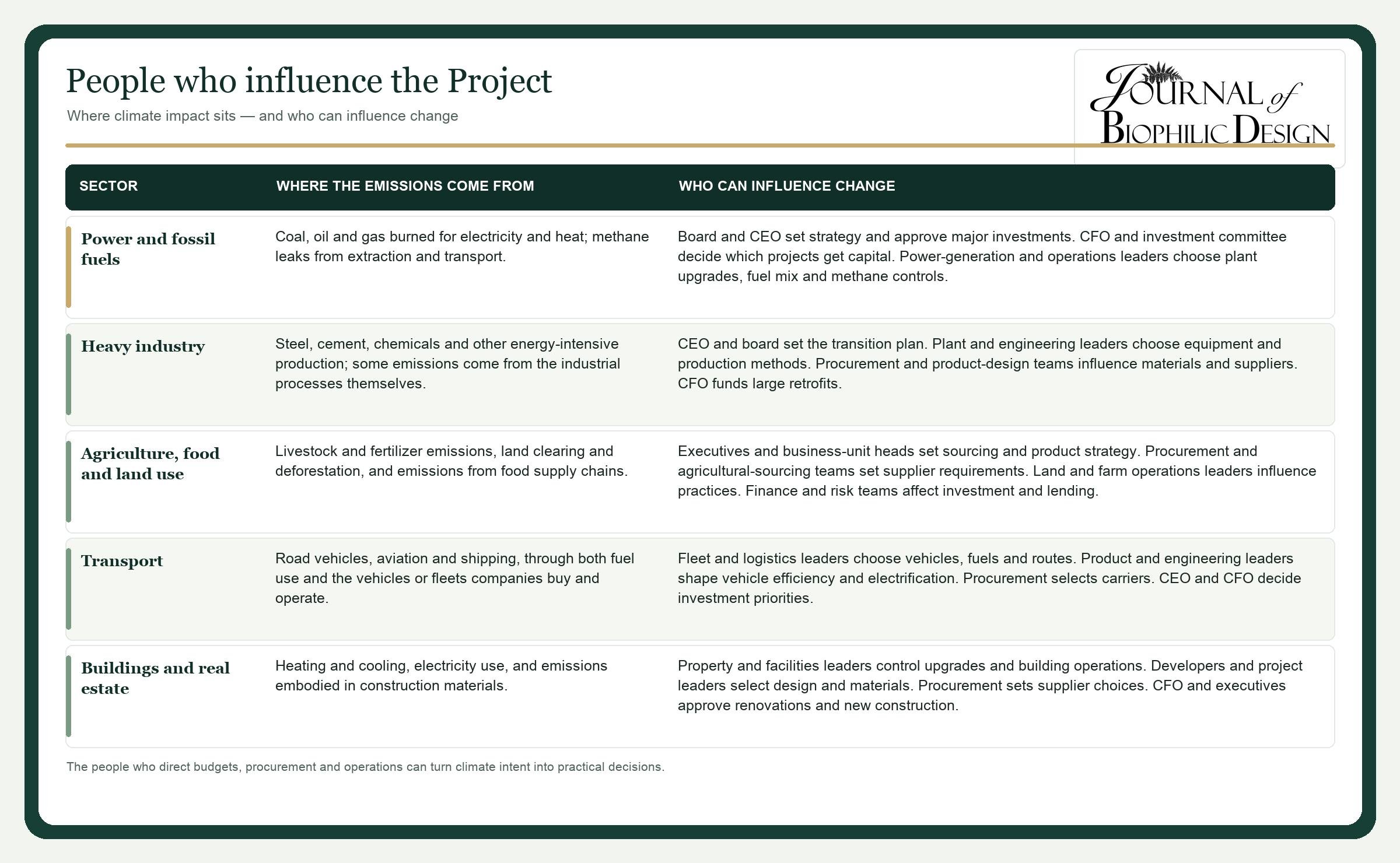
Map the people who influence the project and the choices they control (see matrix above). A sustainability lead may provide targets and evidence; facilities and operations teams understand how the building will perform; procurement selects materials and suppliers; finance assesses costs; and senior leaders or the board may approve major investments.
Bring these perspectives together early. Biophilic design is more likely to shape the outcome when it is considered during site selection, briefing, budgeting and concept design—not added after the main decisions have been made.
3. Connect design choices to climate impact
Identify where the project has the greatest potential to reduce environmental impact. This may include retaining and adapting an existing building, reducing material use, specifying lower-carbon materials, improving energy performance, supporting active travel, or designing landscapes that manage heat and water.
Consider the full life of the project: construction, operation, maintenance and eventual adaptation. Explain the relationship between proposed design choices, expected outcomes and the evidence behind them. Be clear about assumptions, especially where benefits depend on future operation or user behaviour.
4. Make the case in the client’s terms
Present options in a way that supports a decision. Compare their upfront and whole-life costs, operational implications, maintenance needs, likely benefits and environmental outcomes. Where possible, show alternatives: what can be achieved within the current budget, what additional investment could deliver, and what risks or costs may arise if the opportunity is missed.
Use credible evidence, relevant benchmarks and project-specific analysis. Avoid promising that a design feature will automatically produce wellbeing, productivity or financial gains. Instead, explain what the evidence suggests and how the project could assess results after completion.
5. Turn the idea into an actionable commitment
Ask for a clear next step: include a biophilic design objective in the brief, fund a feasibility study, retain an existing landscape feature, trial a design approach, or set measurable requirements for materials, energy and access to nature.
Each commitment needs an owner, a budget, a timescale and a way to review progress. A small pilot can help when the benefits or practicalities are uncertain. Agree in advance what success means and how the learning will inform future projects. There are loads of case studies you can cite and show. Take along a copy of the Journal of Biophilic Design which backs up what you are trying to persuade them (e.g. architecture, climate change, landscape, wood, workplace, materials, etc).
6. Keep the change alive through delivery
Design intent can be lost during procurement, value engineering, construction or handover. Carry the agreed objectives into specifications, tender evaluations, contractor discussions and operational plans. Work with facilities teams so planting, daylight, ventilation and outdoor spaces are maintained as intended.
After occupation, review what was delivered and how it performs. Use feedback from occupants and building data to identify improvements, share lessons and strengthen the case for the next project.
In summary:
Identify the project’s biggest climate impacts across its operations, supply chain and products.
Find the decisions that could reduce those impacts.
Identify who controls the relevant budgets, procurement and operations.
Understand the client’s priorities and constraints.
Present practical options with costs, benefits and climate outcomes.
Agree a specific action, owner, budget and deadline.
Carry the commitment through design, procurement, construction and operation.
Review the results and use them to guide future projects.
Find relevant case studies and evidence in the Journal of Biophilic Design archive as evidence to support you (it’s why we published the Journal in the first place to help bring about change for people and planet, please use it as an industry resource ,and let us know how else we can help).
A practical principle
The goal is to help the people controlling budgets, design choices and operations make a specific, informed decision that brings nature and natural patterns and systems into the project and supports better environmental outcomes.
Biophilic designers can be catalysts for that shift: translating the value of connection to nature into choices that clients can fund, deliver and sustain.
Explore the Journal of Biophilic Design archive to find the issue most relevant to your project. Each themed issue brings together case studies, evidence and practical insights to help support your case for change.
https://journalofbiophilicdesign.com/journal-of-biophilic-design-1
New to Biophilic Design - find out more about what it is here: https://journalofbiophilicdesign.com/what-is-biophilic-design