By Jennifer L. Bryan, Change Leadership Expert and Global Speaker
There is a conversation happening in workplaces right now that most leaders are not fully part of, and it is not just happening in board meetings or leadership away-days. It is happening in the gaps: in the quiet frustration of the team member whose idea was talked over, in the instinct of the specialist whose insight was shelved, in the resignation of the person who stopped raising their hand because nobody seemed to be listening. It is also costing organisations far more than they realise.
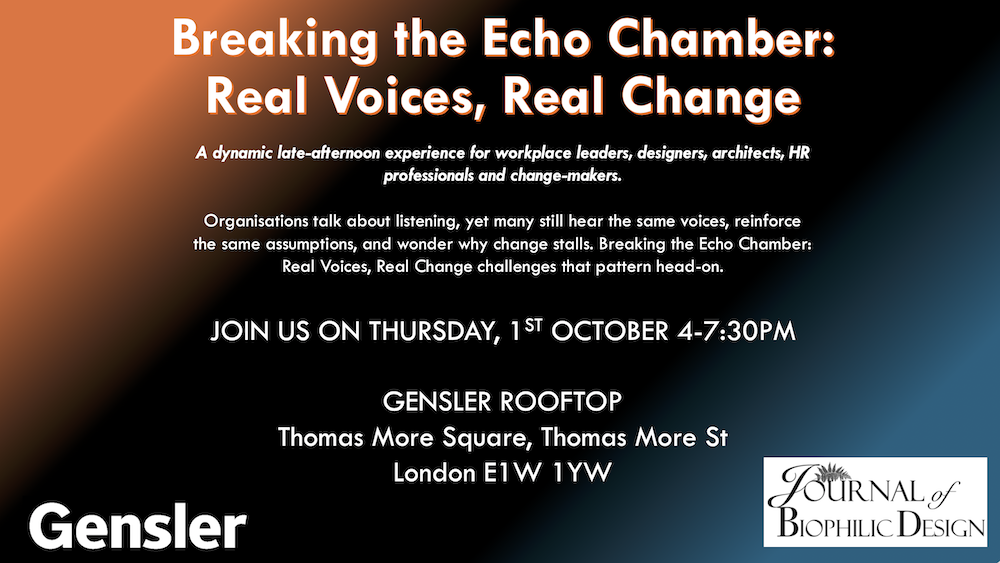
On 1 October 2026, an important event is taking place at Gensler's London studio that speaks directly to this gap. Breaking the Echo Chamber: Real Voices, Real Change, hosted by Jennifer L. Bryan and building on the acclaimed Hearing Women in the Workplace research by Paige Hodsman and Dr Nigel Oseland, promises to move the conversation beyond familiar territory. This is not simply a discussion about gender equity. It is a rigorous examination of whose voices carry weight in organisations, whose insights translate into action and what leaders may be missing as a result. For those of us working at the intersection of human wellbeing and the built environment, the relevance could not be more direct.



The Human Cost of Selective Listening
Biophilic design rests on a foundational conviction that people function better, feel better and contribute more meaningfully when their environments align with their intrinsic human needs. We design for wellbeing. We advocate for spaces that reduce stress, restore attention, support cognitive performance and honour the biological reality of what it means to be human. Even so, the built environment professions are not immune to the very dysfunction they seek to remedy in the spaces they create.
When organisations selectively listen, defaulting to familiar voices, dismissing outlier perspectives, or unconsciously filtering whose input enters the decision-making process, the consequences are well-documented. Innovation slows considerably, culture suffers as a result, and performance declines in turn. The research underpinning this event makes clear that it is not just about who is speaking. It is about who is heard. In rooms where the same voices perpetually dominate, the full intelligence of the organisation never gets to the table.
For biophilic designers, this is not abstract. Designers work in collaborative, multidisciplinary environments where the quality of an outcome depends on whether the acoustic specialist's assessment is genuinely weighted alongside the architect's vision, whether the environmental psychologist's evidence is integrated rather than noted and moved past, whether the end user's lived experience is treated as data. If those voices are being filtered by organisational dynamics we have not examined, we are not practising the full depth of what we profess to believe.
Emotion is not Soft: It is the Signal
My work as a change leader is built on a premise that will resonate strongly with this readership: change fails when leaders treat it as a process problem. In her more than 25 years working with organisations, I have consistently found that the leaders who make change stick are those who understand how their people feel, not merely what they need to do. Emotion is not the obstacle to organisational change. It is, in fact, the intelligence that makes change possible.
This is a principle biophilic design has long understood in relation to space. We know that a person's emotional and physiological response to their environment is not a peripheral concern, it is the core datum. The stress response to a poorly lit, acoustically harsh, nature-deprived interior is not subjective weakness; it is biological truth. My leading change framework applies the same rigour to the social and organisational environment: the emotional temperature of a team, the psychological safety of a meeting room, the felt experience of being truly heard. None of these are soft concerns. They are the conditions in which human potential either flourishes or withdraws.
Breaking the Echo Chamber will bring this understanding directly into conversation. Through a scene-setting presentation of key research findings, a candid expert panel, and structured small-group dialogue designed to move participants from passive listening to purposeful action, the evening creates the kind of professionally challenging space in which real reflection becomes possible. Previous attendees have described it as insightful, inspiring and genuinely uncomfortable in the most productive sense.
Why this Matters to our Community
The Journal of Biophilic Design exists to bridge the gap between research and practice, ensuring that the evidence for nature-informed design reaches the rooms where decisions are made. Evidence only travels as far as the structures of listening will carry it. If the professionals who champion biophilic principles are operating within organisations or client relationships where certain voices are systematically underweighted, the research itself is being filtered before it reaches the decision-maker.
Consider the implications practically. Biophilic design recommendations frequently require advocates within client organisations to champion nature-based solutions in the face of budget pressure, scepticism about return on investment, or simple unfamiliarity with the evidence. The acoustics specialist who understands the restorative value of natural soundscaping must be heard. The wellbeing consultant who can articulate the cognitive benefits of views to nature must be taken seriously. The procurement professional who has absorbed the research on biophilic materials must be trusted. When any of these voices is filtered by hierarchy, by gender, by professional specialism or by personality, the built environment outcome is diminished.
This is why the work I bring to this event, and to my broader practice, is not a parallel conversation to the one this journal advances. It is the same conversation at a different scale. Biophilic design asks what a person needs from their physical environment to be fully human. Breaking the Echo Chamber asks what a person needs from their organisational environment to be fully heard. Both questions, ultimately, are about the conditions for human flourishing.
An Evening Worth Attending
The event takes place at Gensler's London studio, from 4-7:30pm, on 1 October 2026. Delegates will engage with the research, debate the realities of influence and accountability in their own contexts and leave with practical tools for leading change more inclusively and effectively.
The format is deliberately active. This is not an event where expertise flows from a stage to a passive audience. The small-group discussions are designed to generate accountability: to move participants from recognising the problem to committing to a different way of leading. Past participants from organisations including Mott MacDonald, MillerKnoll and The White Company have described it as the kind of evening that stays with you.
For designers, architects, environmental psychologists, workplace strategists and change professionals who care about the full human picture, encompassing the physical environment and the social one, this is an evening that deserves a place in the diary. The built environment is shaped by the conversations that happen before the first line is drawn. Getting those conversations right is, in every meaningful sense, biophilic work.
Breaking the Echo Chamber: Real Voices, Real Change
1 October 2026, 44-7:30 PM
Gensler, Thomas More Street, London E1W 1YW
Tickets: eventbrite.co.uk
About the host: jenniferlbryan.com