A recent poll conducted by Make a Difference Media, revealed 8 main trends Chief People Officers will be addressing in 2026. “CPOs focus on the system. Whereas Health and Wellbeing Leaders tended to ask how to protect health, CPOs tended to ask: what kind of workplace are we actually designing? Across sectors, one word came up again and again: culture. But CPOs are no longer talking about culture as an abstract aspiration. In 2026, it’s being treated as a design project, a performance lever and a leadership accountability. What is striking in CPOs’ priorities for 2026 is not simply what they are focused on, but how they are choosing to act. Culture is no longer treated as a set of values to be communicated, nor wellbeing as a programme to be delivered. Instead, both are being approached as design challenges — questions of systems, environments and everyday conditions that shape behaviour over time.” Editor. Suzy Bashford said.
I would like to respond to this, and outline my thoughts on how Biophilc Design can support CPOs as they race into 2026, as for me, this is precisely where Biophilic Design moves from the margins to the centre of the conversation.
At its core, Biophilic Design is not about plants or aesthetics. It is about designing the conditions in which humans function best, drawing on our innate biological responses to light, nature, materiality, rhythm, refuge, connection and sensory balance. In other words, it provides a tangible way to turn cultural intent into lived experience.

Culture as an operating system is expressed not only through policies and leadership behaviours, but through the environments people inhabit every day. Spatial hierarchy, access to daylight, acoustic control, choice and autonomy, visibility, and opportunities for connection all send powerful signals about what is valued. A workplace that offers psychological safety, dignity, and agency does not rely solely on behavioural KPIs to reinforce culture — it embeds it into the system itself.
Similarly, as leaders become the primary interface of culture, the environments they operate within either support or undermine their ability to lead well. Biophilic workplaces reduce cognitive load, stress and fatigue, enabling better judgement, emotional regulation and decision-making. This matters when leaders are being asked to hold complexity, have difficult conversations and support mental health alongside performance. Capability does not exist in isolation from context.
CPOs’ deliberate reframing of wellbeing as performance infrastructure also aligns strongly with biophilic principles. Decades of research link exposure to natural light, views of nature, sensory variability and restorative spaces with improved concentration, faster recovery from stress, reduced absenteeism and stronger engagement. This is not a trade-off between care and results; it is a performance strategy grounded in human biology.

Perhaps most powerfully, Biophilic Design supports the shift from individual resilience to designing work that works. When CPOs talk about treating workload, role clarity, fairness and utilisation as organisational health hazards, they are acknowledging that wellbeing failures are often systemic. Biophilic Design extends this thinking into the physical and sensory realm — addressing environmental stressors such as noise, glare, crowding, lack of privacy or lack of control, which quietly erode mental health over time.
The elevation of so-called “soft” skills and intentional human connection is also deeply spatial. Connection does not happen by chance. It is shaped by how spaces invite encounter, retreat, collaboration and belonging. Biophilic environments support these relational needs by offering a balance of prospect and refuge, shared and individual spaces, rhythm and variation — enabling community without forcing constant interaction.
Even persistent pressure points such as mental health and financial stress are influenced by environment. Spaces that offer calm, restoration and dignity help regulate nervous systems under sustained pressure. When combined with supportive policies, they reduce the background stress load people carry into their workday.
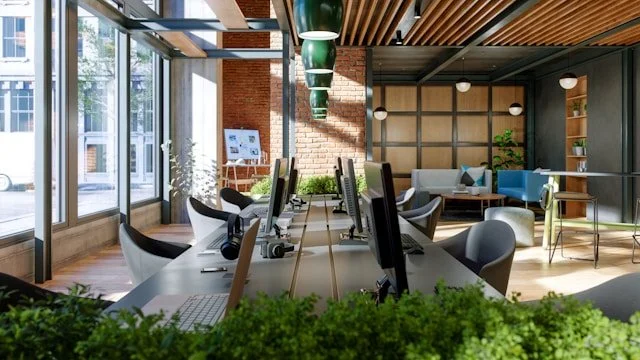
Finally, as organisations navigate AI, ethics and the future of work, Biophilic Design acts as a counterbalance to dehumanisation. It reinforces what remains uniquely human: creativity, empathy, meaning, sensory intelligence and connection to living systems. In environments where technology is accelerating, biophilic principles help ensure that efficiency does not come at the cost of agency, autonomy or trust.
In short, if culture is the operating system, Biophilic Design is part of the hardware. It makes values visible, supports leadership capacity, protects performance and embeds wellbeing into the everyday fabric of work. For CPOs treating culture as a design project rather than an aspiration, it offers not a metaphor — but a method.
This is a response to the results published here: https://makeadifference.media/culture/8-chief-people-officer-priorities-for-2026-and-why/