plantsatwork

Why we need nature inside our buildings - The Future of Healthy Buildings with Biophilic Design

Why we need nature inside our buildings - The Future of Healthy Buildings with Biophilic Design

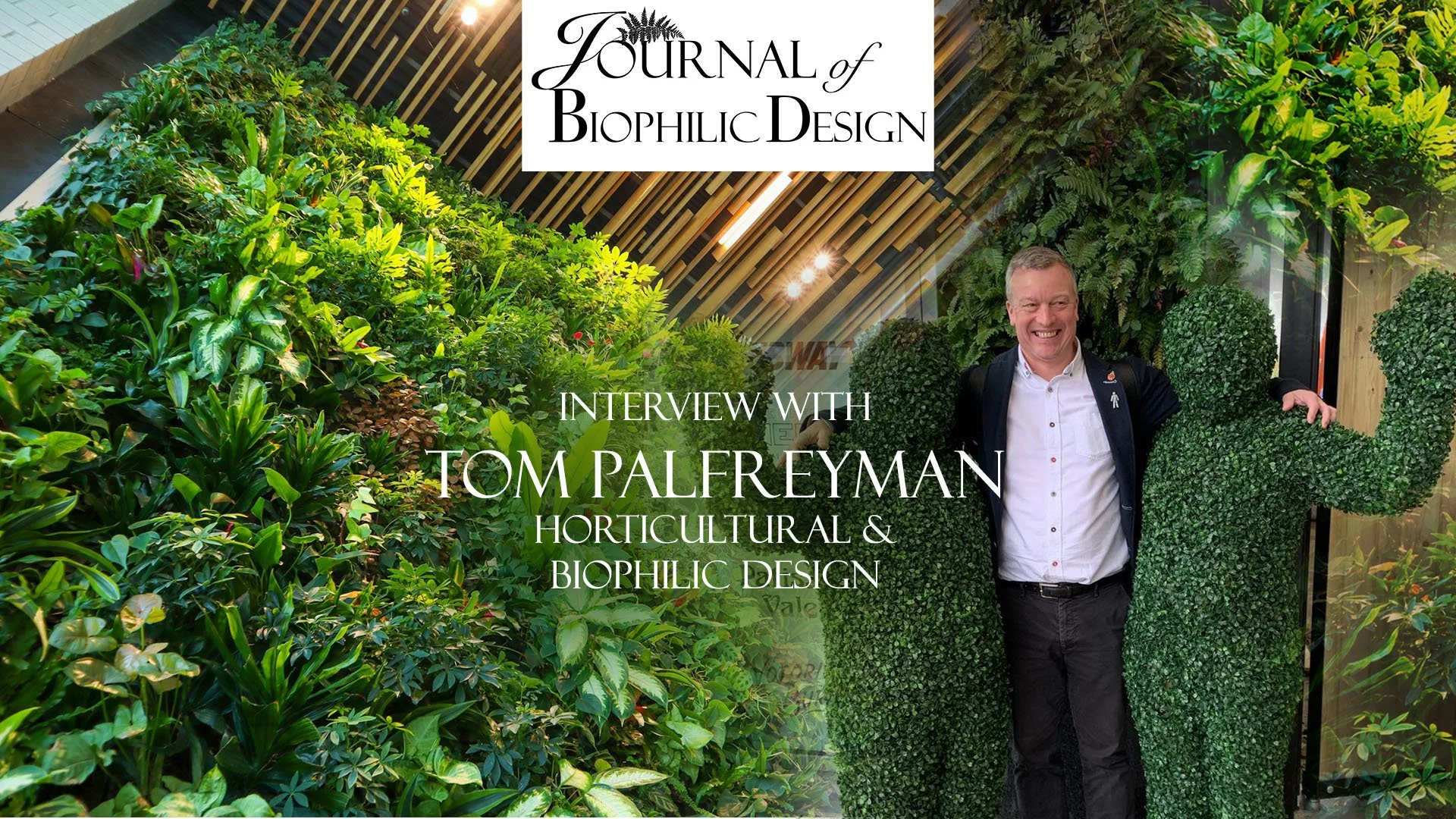
In this episode of the Journal of Biophilic Design podcast, we speak with landscape specialist Tom Palfreyman, whose work across commercial, hospitality, retail and workplace environments has focused on the principle that plants fundamentally change how people experience space. With more than twenty years’ involvement in interior and exterior landscaping, Tom has spent his career exploring how nature can improve the places where we work, rest and play,  and why maintenance, care and long-term thinking are just as important as the initial design itself.


As Tom reflects during the conversation, “Plants have transitioned from a nice-to-have decoration in the corner of the building to being an intrinsic essential part of any building.” It is a shift many designers are now recognising. The conversation around biophilic design has matured significantly over the past decade. What was once dismissed as aesthetic enhancement is increasingly understood as part of a much wider discussion around health, wellbeing, productivity, ecology and human resilience.


The heart of biophilic design beats out that human beings are not separate from nature, we are an intrinsic part of it. “We evolved to live outside,” Tom says. “That connection with nature, sadly, I believe, has been lost.”


Modern life has created increasingly artificial environments - sealed buildings, screen-based working, urban density and spaces designed more for efficiency than human experience. Yet our biology has not changed at the same pace as our architecture. Research across neuroscience, environmental psychology and workplace wellbeing continues to show that exposure to nature can reduce stress, restore attention, support cognitive performance and improve emotional wellbeing.

 READ ON….

Skogluft – Forest Air. Reconnecting people to nature

Skogluft – Forest Air. Reconnecting people to nature

We speak with Morten Kvam, CEO of Skogluft. Not only does it sound beautiful and uplifting, in Norwegian it means “Forest Air”. We talk about how plants are essential to have in the built environment and how the main founder of Skogluft Bjorn Virumdal was a mechanical engineer and realised that biological models were needed to explain the effects of nature indoors. NASA had conducted some research on how astronauts would be affected by the lack of nature. After speaking with them to explore their findings Bjorn then conducted further scientific research to prove how different plants and different light affected people in different working environments.

His research looked at three main aspects: the feeling of being awake, headaches and respiratory problems and he took readings before and after the intervention.

The results showed the positive effects of having nature indoors. Tiredness reduced by 40%, headaches reduced by 35% and concentration problems reduced by 16%. Morten tells us that they have over 7.2kg worth of evidence that nature indoors is good for us!

We also talk about the importance of light. The positive effect of light reflecting on nature. “We are programmed to stay in nature, we have always been surrounded by plants and light together,” Morten says. “It makes people react more positively when we see light reflected on plants.

In his magic brush of biophilia, he says we should be looking to install nature everywhere, and “just like toilets are compulsory in buildings so should nature be compulsory indoors everywhere.” I think I’ll be sharing that last thought many many times. It’s straightforward and simple to grasp - nature should indeed be compulsory in every building.

Plants to the Rescue! #PlantsatWorkWeek2023 LIVE in Oxford!

Plants to the Rescue! #PlantsatWorkWeek2023 LIVE in Oxford!

Live footage! We are really excited to join Plants@Work in Oxford to interview Ian Drummond the concept designer behind this year’s Plants @Work celebration! “Plants to the Rescue”.

An ambulance makes an appearance at the Oxford Business Park. Everyone is keen to know who’s in need of medical help without appearing too nosey. Watching from afar one person noted something wasn’t quite right – plants kept appearing, peeping out of the back of the ambulance and round the corners of the doors. Where was the patient? And what had happened?

Read on and watch!