Workplace Revisited - Print Edition | Issue 23
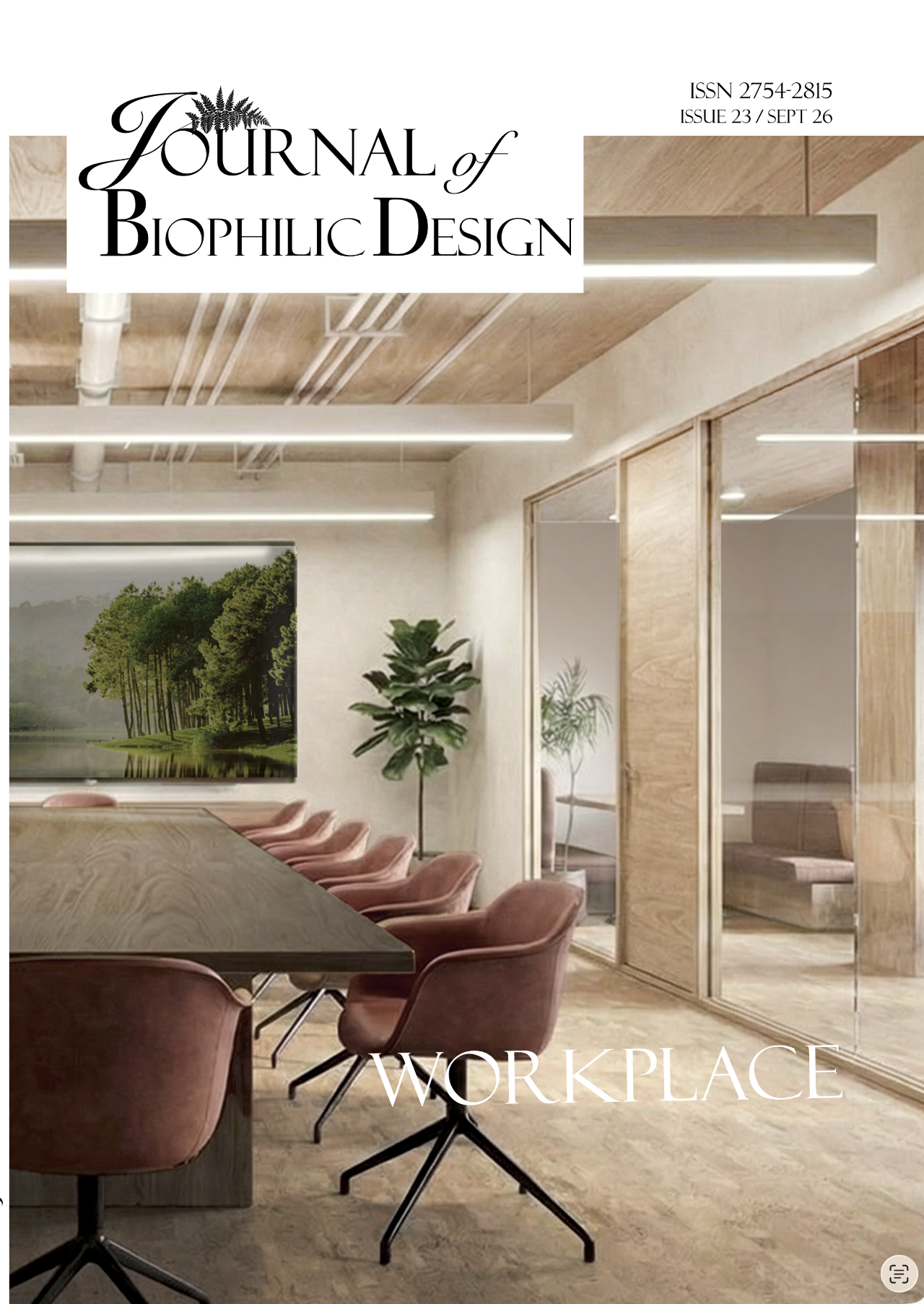
Workplace Revisited - Print Edition | Issue 23
Workplace: What Makes a Better Place to Work?
What does it take to create a workplace that supports people’s health, wellbeing and creativity? Is it the light, the materials, the acoustics, the colours, the presence of nature — or the way all these elements work together?
In this Workplace edition of the Journal of Biophilic Design, we bring together researchers, designers, architects, workplace specialists and practitioners to examine how our working environments affect us, and how Biophilic Design can inform better decisions about the places in which we spend so much of our lives.
The issue explores the evidence behind biophilia, including how wellbeing can be measured and how the value employees place on nature can be understood in social and economic terms. We consider the hidden costs of workplaces that overlook human needs, the sensory demands of modern offices, the importance of light for health and an ageing workforce, and how design can support different ways of thinking, working and creating.
We also look at what happens when these ideas are put into practice. How can an uninspiring office be transformed on a limited budget? What can we learn from a thoughtfully designed wellbeing courtyard? How might workplace gardens, green roofs and urban biodiversity contribute to healthier environments? And how can standards such as WELL help translate research into practical design decisions?
Our contributors challenge familiar assumptions, too. Why do so many offices look the same when nature is diverse, changing and sometimes untidy? Can we move beyond the familiar plant wall towards a richer relationship with the living world? What does it mean to design for people rather than simply provide space for them?
The issue also considers the relationship between workplace design and wider environmental responsibilities, from turning waste into value to understanding what birds and green roofs can tell us about biodiversity and climate change.
For architects, interior designers, facilities managers, HR and people professionals, workplace strategists, business leaders, developers and building owners, these discussions offer different perspectives on a shared challenge: creating environments that work better for the people who use them.
Through research, practical examples and professional experience, this edition explores how Biophilic Design can move beyond aesthetics to inform the way workplaces are planned, commissioned, managed and experienced.
The question is not simply how to make an office greener, but how to create places that work better for people, organisations and the natural world.
Discover the Workplace edition of the Journal of Biophilic Design.
Workplace edition: Meet our contributors
Peter Chambers — Evidence-based Biophilia for Practitioners: applying research to real-world design.
Bettina Therese Møller — Why a workplace should feel like a nice place to be.
Peter Donegan — The Secret Wellbeing Courtyard Garden: landscape design for wellbeing.
Steve Brewer — Challenging formulaic office design and celebrating nature’s untidiness.
Fiza Shaikh — Sensory overload in workplaces and the need for restorative pauses.
Matteo Manzi — How the WELL standard can quantify aspects of Biophilic Design.
Ian Baker — What nature can teach us about workplace strategy.
Fiona McCully, Social Value Portal — Understanding and measuring the value workers place on Biophilic Design.
Nikita Fielder, Benholm — Moving beyond the solitary office plant towards a richer connection with nature.
Sarah Croud — How changing boundaries between work and other spaces can inform better design.
Roddy Clarke — Connecting architecture, communities and urban landscapes.
Marwa Adly — The hidden emotional costs of workplaces that overlook human nature.
Ulysse Dormoy — Biophilic Design, light, healthspan and the ageing workforce.
Heather McLean and colleagues — Translating research into WELL-certified workplaces.
Georgina Spataru — Beyond beige: nature, colour, proportion and wellbeing.
Emi Melin — Rethinking quality through the often-overlooked aspects of interior design.
Ainslie Peters — Designing workplaces around the creative cycle.
Caroline Knight — Moving beyond the plant wall and turning waste into value.
Lou Mahon, RSPB — What birds can tell us about climate change.
Zoe Lay — Research into how green roofs may help defend against microplastics.
London Park Cities — Pollinating our cities and supporting urban nature.
Swati Goorha — Workplace Biophilic Design: professional perspectives and practical insights.
Daria Zalivnov — Workplace Biophilic Design: professional perspectives and practical insights.
Samantha-Jane Agbontaen — Workplace Biophilic Design: professional perspectives and practical insights.
Rubina Chadha — Workplace Biophilic Design: professional perspectives and practical insights.
Gijs Bruggink and colleagues, Orga Architects — The Wood and Wellbeing Report: evidence on how wooden environments affect us.
Rebecca Lynn — The Magic Brush of Biophilia in Australia: transforming an uninspiring office through practical, human-centred design.
Ozge Fettahlioglu — Book review: further reading and ideas for the Biophilic Design community.
Kate Raworth — Book review exploring Doughnut Economics and its relevance to how we think about sustainable systems.


